Blog

  • Income-tax Act 2025 Explained: What Changed From 1 April 2026 and How the Transition Works

    Income-tax Act 2025 Explained: What Changed From 1 April 2026 and How the Transition Works

    Updated: 16 October 2026 | By PK

    The Income-tax Act 2025 replaced the Income-tax Act, 1961 on 1 April 2026, and it applies to income earned from Tax Year 2026-27 onwards. According to the Press Information Bureau, it simplifies the language and structure of the law without changing the underlying tax policy. The bigger practical change is the transition: for the next few years, many taxpayers will deal with both Acts at the same time.

    This guide explains what changed, what did not, and how the old and new laws apply to returns, advance tax, TDS and pending cases. Every figure below comes from the Income Tax Department or PIB.

    What Is the Income-tax Act 2025?

    The Income-tax Bill, 2025 was passed by Parliament on 12 August 2025 and received the President’s assent on 21 August 2025. It then became the Income-tax Act, 2025. As section 1 of the Act states, it came into force on 1 April 2026.

    The government’s stated aim was simplification. The Income Tax Department says the new law contains 536 sections and 16 schedules, compared with 819 sections and 14 schedules in the 1961 Act. Cross-references are more direct, provisos and explanations have been reduced, and many rules are presented in tables.

    The Central Board of Direct Taxes notified the Income-tax Rules, 2026 on 20 March 2026, also effective from 1 April 2026. According to the Department, the rules have been cut from 511 rules and 399 forms to 333 rules and 190 forms.

    “Tax Year” Replaces Previous Year and Assessment Year

    The change most taxpayers will notice first is a new term. The 1961 Act used two different years: the “previous year”, in which income was earned, and the “assessment year”, in which it was assessed. That often confused taxpayers.

    Under the Income-tax Act 2025, there is one term: tax year. The Income Tax Department defines it as the twelve-month period of the financial year in which income is earned. Income earned from 1 April 2026 to 31 March 2027 is therefore “Tax Year 2026-27”.

    The underlying system does not change. Income is still assessed after the year ends, just as previous-year income was assessed under the old Act. Only the label is simpler.
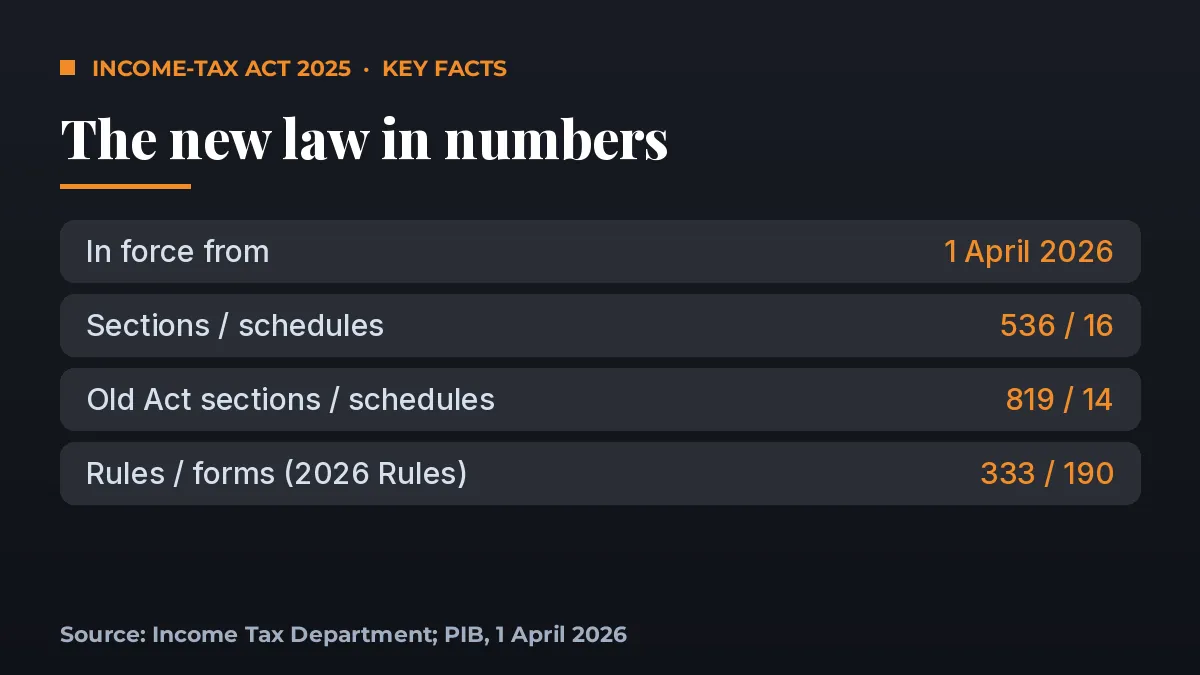
    Income-tax Act 2025 key facts: 536 sections, 16 schedules, in force from 1 April 2026
    The new Act and Rules are shorter than the ones they replace.

    Old Act vs New Act: Which Law Applies When?

    The Income Tax Department has explained that the 1961 Act stands repealed from 1 April 2026, but its provisions continue to govern all tax years beginning before that date. In practice, this means:

    SituationLaw that applies
    Income of FY 2025-26 (AY 2026-27)Income-tax Act, 1961
    ITR for AY 2026-27, filed in 2026Old Act forms
    Advance tax for Tax Year 2026-27 (from June 2026)Income-tax Act 2025
    Income earned from 1 April 2026Income-tax Act 2025
    Assessments and appeals for earlier yearsIncome-tax Act, 1961, until finally resolved

    The e-filing portal supports compliance under both Acts at once. As a result, a business may file an audit report and return under the old Act for FY 2025-26 while paying advance tax and filing TDS statements under the new Act for Tax Year 2026-27.

    For example, tax audit cases for AY 2026-27 are still governed by the 1961 Act. That is why the extended due dates in CBDT Circular No. 07/2026 (tax audit report by 21 October 2026 and return by 21 November 2026) refer to the old framework. See our guide to tax audit thresholds and penalties for the audit rules that apply to that year.

    What Changed and What Did Not

    PIB described the Income-tax Act 2025 as a shift towards clarity, simpler language and a reader-friendly structure “without altering the underlying tax policy”. That is the key point for most taxpayers.

    What changed:

    • Structure and numbering: section numbers are different. A provision you knew by its 1961 section number now sits under a new number.
    • Terminology: “tax year” replaces “previous year” and “assessment year”.
    • Forms: the rules and forms were re-numbered and redesigned. For instance, quarterly TDS statements are now filed on new forms, such as Form 138 for TDS on salary and Form 140 for TDS on other payments to residents.
    • Presentation: more tables and formulas, fewer long provisos.

    What did not change in principle:

    • The broad policy framework for computing and taxing income.
    • Rates and slabs, which continue to be set through annual Finance Acts.
    • The obligation to pay advance tax, deduct TDS and file returns on time.

    That said, Finance Act 2026 amended the new Act before it took effect. So always read the Act “as amended”, which the Department publishes on its website.
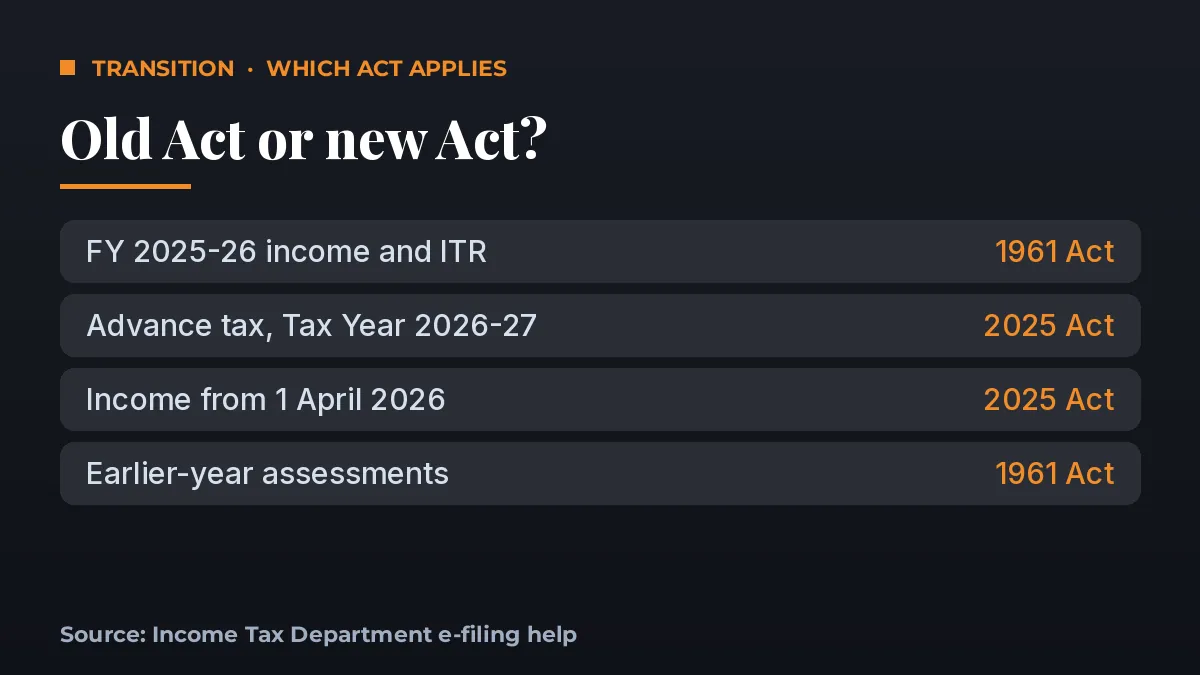
    Transition table showing when the 1961 Act and the new tax law apply
    Both Acts will run side by side for some years.

    How the Income-tax Act 2025 Affects Different Taxpayers

    Salaried employees

    Your employer’s TDS on salary from April 2026 runs under the new Act and the new forms. Your return for FY 2025-26, filed in 2026, used the old Act’s forms. When you plan investments or deductions, check the new section references in your Form 16 equivalent and in declarations to your employer.

    Businesses and professionals

    Advance tax instalments for Tax Year 2026-27 are paid under the new Act. Professionals using presumptive taxation should review how those provisions are numbered and worded now. Our guides on advance tax for professionals and presumptive taxation explain the logic, which continues; check the new section references before filing.

    Deductors and collectors

    TDS and TCS compliance moved to new forms from the first quarter of Tax Year 2026-27. Software, challans and returns must use the new references. For the conceptual difference between TDS on purchases and TCS on sales, see our explainer on TDS on purchase of goods versus TCS on sale.

    Practical Transition Checklist

    1. Map your key sections. Use the Department’s utility that compares provisions of the 1961 Act and Rules with the 2025 Act and 2026 Rules.
    2. Update templates and software. Invoices, TDS certificates, engagement letters and accounting software should use the new references for Tax Year 2026-27.
    3. Keep two files. Separate papers for FY 2025-26 (old Act) and Tax Year 2026-27 (new Act) avoid mix-ups in notices and assessments.
    4. Read the Department’s FAQs. The FAQs on interplay and transition between the two Acts answer many common questions.
    5. Check notices carefully. A notice for an earlier year will cite the 1961 Act. A notice for Tax Year 2026-27 onwards will cite the new Act.

    Five Insights on the New Law

    • In force since 1 April 2026. It applies from Tax Year 2026-27.
    • Simpler, not a new tax policy. PIB says the underlying policy is unchanged.
    • Two Acts run side by side. Earlier years stay under the 1961 Act until closed.
    • Fewer sections and forms. 536 sections and 16 schedules; 333 rules and 190 forms.
    • Numbers changed, so check references. Old section numbers no longer apply to new-year compliance.

    What Happens Next

    The first full returns under the Income-tax Act 2025 will be for Tax Year 2026-27, filed in 2027. Expect more CBDT circulars, FAQs and form updates as that date approaches. Meanwhile, keep an eye on the old-Act deadlines for FY 2025-26, especially the tax audit and return dates extended by Circular 07/2026.

    Frequently Asked Questions

    When did the Income-tax Act 2025 come into force?

    The Income-tax Act 2025 came into force on 1 April 2026, as section 1 of the Act provides and PIB confirmed. It applies to income earned from Tax Year 2026-27 onwards. Income of earlier years continues to be governed by the Income-tax Act, 1961, including assessments and appeals for those years.

    What is a tax year under the new Act?

    A tax year is the twelve-month financial year in which income is earned, from 1 April to 31 March. It replaces the separate “previous year” and “assessment year” used under the 1961 Act. Income earned between 1 April 2026 and 31 March 2027 is Tax Year 2026-27.

    Which Act applies to my return filed in 2026?

    Returns for AY 2026-27, covering income of FY 2025-26, are filed under the Income-tax Act, 1961 using the old Act’s forms. However, advance tax for Tax Year 2026-27, starting June 2026, is paid under the new Act. The e-filing portal supports both.

    Have income tax rates changed because of the new Act?

    PIB says the new Act simplifies the law without changing the underlying tax policy. Rates and slabs continue to be set by annual Finance Acts. So any change in rates comes from the Finance Act for that year, not from the switch to the new Act itself.

    How do I find the new section for an old provision?

    The Income Tax Department has published utilities that map provisions and forms of the 1961 Act and Rules to the 2025 Act and 2026 Rules. You can find them on the Department’s Income-tax Act 2025 page, along with FAQs and guidance notes on the transition.

    Sources

    Disclaimer: This article is general information, not professional tax advice. Please consult a Chartered Accountant for your specific situation.

  • TDS Under Section 194Q vs TCS Under Section 206C(1H): Rules & Limits

    By PK

    Statutory Background of High-Value Transaction Tracking

    To expand the formal tax base and track high-value commercial transactions in real time, the Finance Act introduced complementary withholding provisions: Section 206C(1H) (Tax Collection at Source by sellers) and Section 194Q (Tax Deduction at Source by buyers).

    Because both provisions target the sale and purchase of goods exceeding ₹50 Lakh in a financial year, commercial enterprises frequently encounter overlapping compliance conflicts. Establishing clear statutory priority rules is vital for preventing dual withholding or compliance defaults.

    Section 194Q: TDS on Purchase of Goods

    1. Applicability Criteria

    Section 194Q mandates tax deduction at source by a buyer responsible for paying any sum to a resident seller for purchase of goods. Applicability requires two conditions:

    • Buyer’s Turnover: Total sales, turnover, or gross receipts of the buyer must exceed ₹10 Crore in the immediately preceding financial year.
    • Transaction Value: Aggregate purchases from a specific seller exceed ₹50 Lakh in the current financial year.

    2. Rate and Timing of Deduction

    • Withholding Rate: 0.1% on the amount exceeding ₹50 Lakh. If the seller fails to furnish a valid PAN, the rate escalates to 5% under Section 206AA.
    • Timing: Deduction must occur at the time of credit of such sum to the account of the seller or at the time of payment, whichever is earlier.

    Section 206C(1H): TCS on Sale of Goods

    1. Applicability Criteria

    Section 206C(1H) requires a seller to collect tax from a buyer upon receipt of sale consideration:

    • Seller’s Turnover: Total turnover of the seller must exceed ₹10 Crore in the immediately preceding financial year.
    • Receipt Value: Aggregate sale consideration received from a specific buyer exceeds ₹50 Lakh in the current fiscal year.

    2. Rate and Timing of Collection

    • Collection Rate: 0.1% on the consideration received exceeding ₹50 Lakh (1% in non-PAN cases).
    • Timing: Collection is strictly linked to actual receipt of consideration, regardless of invoice booking dates.

    The Rule of Precedence: Which Section Prevails?

    When both the buyer and the seller possess annual turnover exceeding ₹10 Crore, Section 194Q takes absolute statutory precedence over Section 206C(1H):

    • Under Section 206C(1H)(proviso), TCS is not required if the buyer is liable to deduct TDS under any other provision (including Section 194Q) and has deducted such amount.
    • Therefore, the buyer must deduct TDS under Section 194Q. The seller must not charge TCS once confirmed that the buyer has complied with Section 194Q.
    • If the buyer’s turnover is below ₹10 Crore but the seller’s turnover exceeds ₹10 Crore, Section 194Q does not apply, and the seller must collect TCS under Section 206C(1H).

    Statutory Sanctions for Default Under Section 40(a)(ia)

    Non-compliance with Section 194Q carries direct financial consequences:

    • Failure to deduct or deposit TDS triggers a 30% disallowance of the expenditure under Section 40(a)(ia), directly increasing corporate taxable profits.
    • Mandatory interest under Section 201(1A) is levied at 1% to 1.5% per month for deduction or payment delays.

    Best Practice Implementation Framework

    To ensure flawless enterprise compliance:

    • Conduct an annual turnover audit of all major vendors and customers at the beginning of each fiscal year.
    • Obtain formal Section 194Q declarations from corporate buyers confirming their duty to deduct tax.
    • Configure ERP enterprise systems to halt duplicate TCS invoicing on customer accounts subject to Section 194Q TDS.

    Professional Conclusion

    Navigating the interface between Section 194Q and Section 206C(1H) requires rigorous vendor-customer communication and automated ERP controls. Maintaining systematic threshold monitoring eliminates disallowances and ensures institutional tax compliance.

    Related Tax Withholding & Corporate Guides

    Authoritative Statutory References


    Professional & Regulatory Disclaimer:

    The content published on this website is intended solely for general informational and educational purposes. It does not constitute individualized financial, investment, accounting, or tax advice, nor does it create a professional–client relationship. Tax statutes, regulatory circulars, and judicial interpretations change frequently; individuals and business owners must verify the prevailing legal position or consult a qualified professional before making decisions based on this information.

  • Presumptive Taxation Under Section 44AD and 44ADA: Eligibility & Limits

    By PK

    Overview of the Presumptive Taxation Framework

    The presumptive taxation regime under Sections 44AD, 44ADA, and 44AE of the Income-tax Act, 1961, was enacted to reduce compliance burdens for micro, small, and medium enterprises (MSMEs) and independent professionals. Under this framework, eligible taxpayers can declare their business or professional income at fixed statutory percentage rates without maintaining elaborate books of account or undergoing mandatory tax audits.

    Understanding the specific statutory boundaries of Section 44AD (businesses) and Section 44ADA (professionals) is essential for optimizing tax liability while remaining in strict regulatory compliance.

    Section 44AD: Presumptive Taxation for Small Businesses

    1. Eligible Businesses and Assessees

    Section 44AD is available to resident individuals, Hindu Undivided Families (HUFs), and partnership firms (excluding Limited Liability Partnerships). It applies to any business enterprise except:

    • Assessees plying, hiring, or leasing goods carriages (covered under Section 44AE).
    • Persons engaged in agency businesses or earning brokerage/commission.
    • Persons carrying on notified professions under Section 44AA(1).

    2. Turnover Limits and Presumptive Profit Percentages

    • Standard Turnover Limit: Up to ₹2 Crore during the financial year.
    • Enhanced Turnover Limit: Elevated to ₹3 Crore if aggregate cash receipts do not exceed 5% of total turnover.
    • Presumptive Rates: Income is estimated at a minimum of 8% of total turnover. However, for turnover realized through account payee cheques, drafts, ECS, or prescribed digital modes, the rate is reduced to 6%.

    3. The 5-Year Lock-in Rule (Section 44AD(4))

    Taxpayers opting out of Section 44AD after declaring presumptive profits must note a stringent restriction: if an assessee opts out within five consecutive assessment years, they are barred from claiming Section 44AD benefits for the subsequent five years and must undergo mandatory audit under Section 44AB if their income exceeds the basic exemption limit.

    Section 44ADA: Presumptive Taxation for Professionals

    1. Eligible Notified Professions

    Section 44ADA applies exclusively to resident individuals and partnership firms (other than LLPs) engaged in notified professions:

    • Legal, medical, engineering, architectural, and accountancy professions.
    • Technical consultancy, interior decoration, and notified information technology services.

    2. Gross Receipts Thresholds and Profit Rates

    • Standard Receipts Limit: Up to ₹50 Lakh in gross receipts.
    • Enhanced Limit: Elevated to ₹75 Lakh provided aggregate cash receipts do not exceed 5% of total gross receipts.
    • Presumptive Profit: A minimum of 50% of gross professional receipts is treated as taxable business profits.

    3. Exemption from Bookkeeping and Multi-Installment Advance Tax

    Professionals opting for Section 44ADA are exempt from maintaining formal books of account under Section 44AA. Furthermore, under Section 211, they are relieved from paying quarterly advance tax installments; they are required to pay 100% of their advance tax in a single installment on or before 15th March.

    Strategic Comparative Analysis: Regular Books vs Presumptive Regime

    When evaluating whether to adopt presumptive taxation:

    • High-Expense Structures: If genuine business expenses exceed 92% (for businesses) or 50% (for professionals), opting for regular accounting and tax audit under Section 44AB preserves lower taxable income.
    • Administrative Economy: For lean consultancy practices or digital retailers with minimal overheads, presumptive schemes eliminate bookkeeping overhead and provide audit immunity.

    Professional Conclusion

    Presumptive taxation represents an efficient statutory mechanism for eligible taxpayers. By verifying digital transaction percentages and forecasting profit margins accurately, professionals and entrepreneurs can streamline compliance and maintain robust fiscal hygiene.

    Related Small Business & Professional Tax Guides

    Authoritative Statutory References


    Professional & Regulatory Disclaimer:

    The content published on this website is intended solely for general informational and educational purposes. It does not constitute individualized financial, investment, accounting, or tax advice, nor does it create a professional–client relationship. Tax statutes, regulatory circulars, and judicial interpretations change frequently; individuals and business owners must verify the prevailing legal position or consult a qualified professional before making decisions based on this information.

  • GST Input Tax Credit Reconciliation: Rule 36(4) and GSTR-2B Rules

    By PK

    Overview of Input Tax Credit Mechanics Under GST

    Input Tax Credit (ITC) serves as the core foundation of the Goods and Services Tax framework, preventing cascading tax effects across supply chains. Under the statutory provisions of Section 16 of the Central Goods and Services Tax (CGST) Act, 2017, registered assessees are entitled to claim credit for input taxes paid on business inputs, input services, and capital assets.

    However, amendments introduced via Section 16(2)(aa) and Rule 36(4) have eliminated provisional credit claims. Taxpayers can now claim ITC exclusively if their supplier has filed the corresponding outward return (GSTR-1) and the invoice details appear in the auto-populated GSTR-2B statement.

    Statutory Conditions Under Section 16(2)

    To claim input tax credit legally, an assessee must satisfy all five statutory benchmarks:

    • Possession of Tax Invoice: The taxpayer must hold a valid tax invoice or debit note issued by a registered supplier.
    • Physical Receipt of Goods/Services: Goods or services must have been received by the taxpayer or delivered on their direction.
    • Tax Deposited by Supplier: The supplier must have paid the applicable tax to the government either in cash or through eligible credit utilization.
    • Valid GSTR-3B Filing: The purchasing taxpayer must file their monthly or quarterly return under Section 39.
    • GSTR-2B Appearance: Under Section 16(2)(aa), the invoice must appear in the auto-generated GSTR-2B statement for the specific tax period.

    The Operational Significance of GSTR-2B vs GSTR-2A

    A critical operational distinction exists between GSTR-2A and GSTR-2B:

    • GSTR-2A is Dynamic: It updates continuously as suppliers file late returns, altering historical figures across past accounting periods.
    • GSTR-2B is Static: Generated on the 14th of every month, GSTR-2B provides a fixed snapshot of eligible and ineligible credits for that tax cycle. Statutory ITC claims in Form GSTR-3B must reconcile precisely against GSTR-2B.

    Common ITC Reconciliation Mismatches and Resolution Strategies

    Discrepancies between purchase registers and GSTR-2B typically stem from four distinct administrative errors:

    1. Invoice Number or Date Typos

    When suppliers input incorrect invoice numbers or inverted dates in GSTR-1, automated reconciliation algorithms flag false mismatches. Purchase ledgers must maintain cross-referencing capabilities to verify vendor GSTINs and taxable values.

    2. Ineligible Credits Under Section 17(5)

    Blocked credits—such as motor vehicles, personal consumption items, employee health insurance (unless statutorily mandated), and goods lost or destroyed—must be segregated immediately. Claiming blocked credits exposes assessees to mandatory interest under Section 50.

    3. Supplier Late Filing

    When a supplier files GSTR-1 after the 11th or 13th of the month, their invoices do not appear in the current cycle’s GSTR-2B. These credits must be deferred to the subsequent month’s return rather than claimed prematurely.

    4. Non-Payment Within 180 Days

    Under the second proviso to Section 16(2), if the recipient fails to pay the supplier within 180 days from the invoice date, the proportionate ITC claimed must be reversed along with interest calculated from the initial claim date.

    Strategic Year-End Reconciliation Protocol

    To maintain an audit-ready compliance posture:

    • Perform monthly vendor-level GSTR-2B reconciliations before finalizing Form GSTR-3B payments.
    • Institute a structured vendor tracking matrix to withhold GST portions for non-compliant suppliers until invoices reflect in GSTR-2B.
    • Complete full annual reconciliations before the statutory cutoff date under Section 16(4) (30th November following the end of the financial year).

    Professional Conclusion

    Systematic GST input tax credit reconciliation is not merely an accounting routine—it is a vital financial safeguard. Businesses that maintain automated invoice-level matching protect operating liquidity, avoid costly show-cause notices, and ensure total statutory alignment.

    Related GST Compliance Resources

    Authoritative Statutory References


    Professional & Regulatory Disclaimer:

    The content published on this website is intended solely for general informational and educational purposes. It does not constitute individualized financial, investment, accounting, or tax advice, nor does it create a professional–client relationship. Tax statutes, regulatory circulars, and judicial interpretations change frequently; individuals and business owners must verify the prevailing legal position or consult a qualified professional before making decisions based on this information.

  • Tax Audit Thresholds Under Section 44AB: Rules, Limits & Penalties

    Tax Audit Thresholds Under Section 44AB: Rules, Limits & Penalties

    By PK

    Statutory Framework and Turnover Thresholds

    Under Section 44AB of the Income-tax Act, 1961, every person carrying on a business or profession is required to have their accounts audited by a practicing Chartered Accountant if sales, turnover, or gross receipts cross statutory benchmarks.

    The audit thresholds are structured into distinct tiers based on transaction characteristics and professional status:

    1. Business Assessees with High Digital Transactions (The ₹10 Crore Rule)

    To promote non-cash banking transactions, the statutory audit limit is elevated to ₹10 Crore if:

    • Aggregate cash receipts during the financial year do not exceed 5% of total turnover or gross receipts, AND
    • Aggregate cash payments (including capital expenditure) do not exceed 5% of total disbursements.

    2. Business Assessees Operating in Cash (The ₹1 Crore Threshold)

    If cash receipts or cash payments exceed 5% of total transactions, the statutory turnover threshold reverts strictly to ₹1 Crore. Any business with turnover exceeding ₹1 Crore operating above the cash threshold must undergo mandatory tax audit.

    3. Professionals (Section 44AB(b))

    For assessees engaged in notified professions (engineering, architecture, accountancy, technical consultancy, legal, medicine, interior decoration):

    • The tax audit threshold is fixed at gross receipts exceeding ₹50 Lakh.
    • However, if the professional assesses income under the presumptive provisions of Section 44ADA (with receipts up to ₹75 Lakh and cash receipts below 5%), tax audit is required only if profits declared fall below 50% of gross receipts and total income exceeds the basic exemption limit.

    Key Compliance Considerations & Reconciliations

    Fulfilling tax audit obligations requires disciplined financial accounting and rigorous reconciliation between various statutory statements:

    • Reconciliation with GST Returns: Turnover reported in Form 3CD must be reconciled with GSTR-1, GSTR-3B, and the annual return GSTR-9. Any discrepancies in unbilled revenue or credit notes must be documented.
    • Scrutiny of Cash Receipts and Expenses: Tax auditors examine compliance with Section 40A(3) regarding disallowance of cash payments exceeding ₹10,000, as well as Section 269ST regarding receipt of cash.
    • Verification of TDS/TCS Deductions: Timely deduction and deposit of tax deducted at source under Chapter XVII-B must be verified against Form 26AS.

    Penalties for Non-Compliance Under Section 271B

    Failure to get accounts audited or failure to submit the audit report before the specified statutory due date attracts a penalty under Section 271B. The penalty amount is calculated as 0.5% of total sales, turnover, or gross receipts, subject to a maximum statutory cap of ₹1,50,000, unless justifiable reasonable cause is demonstrated.

    Professional Conclusion

    Navigating tax audit thresholds demands rigorous recordkeeping throughout the financial year. Business owners and professionals who track transaction ledgers quarterly ensure smooth audit sign-offs and prevent compounding compliance costs.

    Related Statutory Audit & Tax Guides

    Authoritative Statutory References


    Professional & Regulatory Disclaimer:

    The content published on this website is intended solely for general informational and educational purposes. It does not constitute individualized financial, investment, accounting, or tax advice, nor does it create a professional–client relationship. Tax statutes, regulatory circulars, and judicial interpretations change frequently; individuals and business owners must verify the prevailing legal position or consult a qualified professional before making decisions based on this information.

  • Advance Tax for Professionals: Calculation Rules, Due Dates & Penalties

    Advance Tax for Professionals: Calculation Rules, Due Dates & Penalties

    By PK

    Overview of Advance Tax Obligations

    Advance tax refers to the phased payment of income tax liabilities during the financial year in which the income is earned, rather than settling the entire amount as a lump sum upon filing the annual return. Under Section 208 of the Income-tax Act, 1961, every taxpayer whose estimated tax liability for the year exceeds ₹10,000 (after reducing TDS/TCS credits) is required to pay advance tax.

    For independent professionals—including chartered accountants, medical practitioners, legal consultants, and technical consultants—cash inflows are frequently uneven throughout the fiscal period. A disciplined framework for projecting income and tax liabilities is essential to avoid compounding statutory interest charges.

    Presumptive Taxation Scheme (Section 44ADA) vs Standard Provisions

    The compliance obligations differ significantly depending on whether a professional assesses income under the presumptive scheme or normal accounting provisions:

    1. Professionals Under Section 44ADA

    Eligible professionals who offer at least 50% of gross receipts as taxable profits under Section 44ADA enjoy a simplified compliance timeline. Unlike commercial business assessees, they are not obligated to deposit advance tax across quarterly installments. Instead, they must deposit 100% of their estimated tax liability in a single installment on or before 15th March of the financial year.

    2. Professionals Under Regular Books of Account

    Professionals who maintain formal books of account under Section 44AA are required to comply with the standard four-installment schedule:

    • 15th June: Not less than 15% of estimated tax liability
    • 15th September: Not less than 45% of estimated tax liability
    • 15th December: Not less than 75% of estimated tax liability
    • 15th March: 100% of estimated tax liability

    Statutory Interest Under Section 234B & Section 234C

    Failure to adhere to the prescribed schedules triggers mandatory interest levies:

    • Section 234C (Deferment of Installments): Levied at simple interest of 1% per month for three months on the shortfall amount between the required statutory percentage and the actual tax deposited by each installment date.

    • Section 234B (Default in Payment of Advance Tax): If total advance tax deposited before 31st March falls below 90% of the assessed tax, interest is levied at 1% per month from 1st April of the assessment year until the date of full payment.

    Strategic Year-End Review Checklist

    To avoid unexpected penalties and ensure seamless compliance:

    • Regularly reconcile Form 26AS, AIS, and TIS to verify all TDS credits deducted by clients.
    • Review advance tax payments prior to the 15th March deadline to ensure the 90% threshold under Section 234B is met.
    • Maintain separate liquid reserves for anticipated tax obligations rather than relying on projected year-end cash flows.

    Professional Conclusion

    Advance tax compliance is fundamentally an exercise in structured financial discipline. By accurately forecasting gross receipts and monitoring TDS reconciliations quarterly, professionals can protect earnings from avoidable statutory interest and maintain audit-ready financial posture.

    Related Tax Planning Resources

    Authoritative Statutory References


    Professional & Regulatory Disclaimer:

    The content published on this website is intended solely for general informational and educational purposes. It does not constitute individualized financial, investment, accounting, or tax advice, nor does it create a professional–client relationship. Tax statutes, regulatory circulars, and judicial interpretations change frequently; individuals and business owners must verify the prevailing legal position or consult a qualified professional before making decisions based on this information.