Blog

  • New vs Old Tax Regime: Slab Comparison, Deductions & Form 10-IEA Rules

    By PK

    Overview of the Dual Tax Regime Framework

    The Indian direct tax landscape offers assessees a structural choice between two alternative taxation regimes: the Default New Tax Regime governed by Section 115BAC of the Income-tax Act, 1961, and the traditional Old Tax Regime.

    Recent legislative amendments have enhanced the attractiveness of the New Tax Regime by widening slab intervals, increasing the standard deduction for salaried individuals to ₹75,000, and providing full tax rebates under Section 87A for net taxable incomes up to ₹7,00,000 (effectively ₹7,75,000 for salaried employees).

    Understanding the financial inflection points and statutory opt-out rules via Form 10-IEA is essential for every taxpayer seeking to minimize net tax outgo.

    Statutory Slab Rates Comparison

    1. New Tax Regime Slabs (Section 115BAC)

    • Up to ₹3,00,000: Nil
    • ₹3,00,001 to ₹7,00,000: 5%
    • ₹7,00,001 to ₹10,00,000: 10%
    • ₹10,00,001 to ₹12,00,000: 15%
    • ₹12,00,001 to ₹15,00,000: 20%
    • Above ₹15,00,000: 30%

    Statutory Rebate: Under Section 87A, resident individuals whose total income does not exceed ₹7,00,000 receive a 100% tax rebate, resulting in zero tax liability.

    2. Old Tax Regime Slabs (Standard General Rates)

    • Up to ₹2,50,000: Nil
    • ₹2,50,001 to ₹5,00,000: 5%
    • ₹5,00,001 to ₹10,00,000: 20%
    • Above ₹10,00,000: 30%

    Statutory Rebate: Section 87A rebate is capped at ₹12,500 for total income up to ₹5,00,000.

    Deductions and Exemptions: Permissible vs Forgone Under Section 115BAC

    1. Key Exemptions Forgone Under the New Regime

    To access lower headline tax rates under Section 115BAC, taxpayers must forgo standard itemized deductions:

    • Leave Travel Concession (LTC) under Section 10(5).
    • House Rent Allowance (HRA) under Section 10(13A).
    • Official allowances under Section 10(14) (helper, uniform, academic allowance).
    • Interest on housing loan for self-occupied property up to ₹2,00,000 under Section 24(b).
    • Chapter VI-A deductions: Section 80C (PPF, ELSS, EPF, Life Insurance up to ₹1.5L), Section 80D (Health Insurance), Section 80TTA/80TTB (Savings interest), Section 80G (Donations).

    2. Allowable Deductions Under the New Regime

    Taxpayers retain specific deductions under the new regime:

    • Standard Deduction: ₹75,000 for salaried individuals and pensioners.
    • Family Pension Deduction: Standard deduction up to ₹25,000 under Section 57(iia).
    • Employer’s NPS Contribution: Allowed under Section 80CCD(2) up to 14% of salary for government employees and 14% for private sector employees.
    • Transport allowance for divyang employees.

    Break-Even Analysis: When Does the Old Regime Outperform?

    The financial decision hinges on the aggregate value of itemized deductions available to the taxpayer:

    • Salaried Individual with Low Deductions (<₹3.75 Lakh): The New Tax Regime consistently delivers higher take-home pay due to wider lower-bracket slabs and the enhanced ₹75,000 standard deduction.
    • Individual with Substantial Deductions (>₹4.25 Lakh): Taxpayers servicing significant home loans (₹2 Lakh interest deduction under Section 24b), maximizing Section 80C (₹1.5 Lakh), paying family health insurance under Section 80D (₹50,000 to ₹1,00,000), and claiming substantial HRA benefit lower aggregate tax liabilities under the Old Regime.

    Statutory Opt-Out Rules: Mandatory Filing of Form 10-IEA

    Because the New Tax Regime is the statutory default option under Section 115BAC:

    1. For Salaried Taxpayers (Without Business/Professional Income)

    Salaried individuals can choose between the new and old regimes on a year-to-year basis directly in their annual ITR filing on or before the due date under Section 139(1). They are not required to submit Form 10-IEA.

    2. For Assessees with Business or Professional Income

    Individuals, HUFs, and partnership firms having business or professional earnings face stringent restrictions:

    • To opt for the Old Tax Regime, they must file Form 10-IEA on or before the statutory due date under Section 139(1) (e.g., 31st July or 31st October).
    • One-Time Switching Rule: Assessees with business income can opt out of the new regime only once in their lifetime. If they subsequently opt back into the new regime, they are permanently barred from switching back to the old regime, unless they cease to have any business income.

    Related Direct Tax Resources

    Authoritative Statutory References

    Professional Conclusion

    Choosing between the New and Old Tax Regimes requires a detailed mathematical projection rather than a generalized assumption. By calculating the total available exemptions against the Section 115BAC rate advantages and filing Form 10-IEA before the statutory deadline where applicable, taxpayers ensure total statutory optimization.


    Professional & Regulatory Disclaimer:

    The content published on this website is intended solely for general informational and educational purposes. It does not constitute individualized financial, investment, accounting, or tax advice, nor does it create a professional–client relationship. Tax statutes, regulatory circulars, and judicial interpretations change frequently; individuals and business owners must verify the prevailing legal position or consult a qualified professional before making decisions based on this information.

  • MCA Director KYC DIR-3 Rules: Filing Deadlines, Penalties & Reactivation

    By PK

    Statutory Framework of Mandatory Director KYC

    Under the mandate of Rule 12A of the Companies (Appointment and Qualification of Directors) Rules, 2014, every individual who holds a Director Identification Number (DIN) or Designated Partner Identification Number (DPIN) as of 31st March of a financial year must submit their Know Your Customer (KYC) details annually to the Ministry of Corporate Affairs (MCA).

    This mandatory annual compliance applies universally to all directors—including resident directors, non-resident directors, independent directors, nominee directors, and even disqualified directors—regardless of whether the company is actively operating or dormant.

    Critical Distinction: DIR-3 KYC Web vs DIR-3 KYC e-Form

    1. DIR-3 KYC Web Service (OTP-Based)

    The web-based KYC service is an expedited, paperless procedure available to directors who meet two criteria:

    • The director has already filed an e-Form DIR-3 KYC in any previous financial year; and
    • There are no changes in personal details (name, nationality, address, mobile number, or email address).

    The director logs into the MCA V3 portal, confirms the pre-populated mobile number and email ID, and submits dual One-Time Passwords (OTPs) without attaching identity documents or obtaining DSC certification.

    2. DIR-3 KYC e-Form (Comprehensive Filing)

    Filing the comprehensive standalone e-Form DIR-3 KYC is mandatory under three circumstances:

    • First-Time Filers: Directors who have been allotted a DIN during the previous financial year and are completing KYC for the first time.
    • Update of Personal Information: Directors updating residential address, passport numbers, personal email, or mobile credentials.
    • Mandatory attachments include self-attested copies of PAN card, proof of identity (Aadhaar / Passport / Voter ID), proof of residential address (bank statement, utility bill not older than 2 months), and Digital Signature Certificate (DSC) certification by a practicing Chartered Accountant, Company Secretary, or Cost Accountant.

    Statutory Due Date and Financial Penalties

    • Standard Due Date: The statutory deadline for completing annual Director KYC is 30th September of the immediately following financial year.
    • Statutory Late Filing Fee: If a director fails to complete KYC on or before 30th September, the DIN status is marked as ‘Deactivated due to non-filing of DIR-3 KYC’.
    • To restore the DIN, the director must pay a non-negotiable statutory late fee of ₹5,000 per DIN under the Companies (Registration Offices and Fees) Rules, 2014.

    Severe Corporate Legal Repercussions of DIN Deactivation

    A deactivated DIN paralyzes corporate governance functions:

    • Inability to Sign Statutory Returns: The director cannot digitally sign any company filings, including annual financial statements (AOC-4), annual returns (MGT-7), or board resolutions.

    • Company Default Liabilities: Delays in company filings caused by director deactivation expose the corporate entity to cumulative additional fees of ₹100 per day per form.

    • Disqualification and Directorship Vacancies: Prolonged failure to participate in board functions or sign returns risks triggering disqualification under Section 164(2) of the Companies Act, 2013.

    Step-by-Step Procedure to Reactivate a Deactivated DIN

    • Access MCA V3 Portal: Log in with registered or business user credentials on the MCA portal.

    • Verify DSC Validity: Ensure the director holds an active Class 3 Digital Signature Certificate mapped to their PAN and DIN.

    • Download e-Form DIR-3 KYC: Access the form under MCA Services -> Company Forms Download.

    • Collate KYC Documents: Obtain self-attested copies of PAN, address proof, and passport (mandatory for foreign nationals, duly apostilled/notarized).

    • Professional Certification: Have the e-form digitally signed and certified by an independent practicing CA, CS, or CMA.

    • Generate Challan and Pay ₹5,000: Upload the e-form on the MCA V3 portal and execute payment of the ₹5,000 late fee via credit card, net banking, or NEFT.

    • Verify DIN Status: Once the payment is confirmed, the MCA system instantly restores the DIN status to ‘Approved’.

    Related Corporate Governance Guides

    Authoritative Statutory References

    Professional Conclusion

    Director KYC is a mandatory annual legal prerequisite, not an optional exercise. Ensuring completion of DIR-3 KYC well before the statutory cutoff date safeguards personal director credentials, protects corporate standing, and avoids unnecessary financial penalties.


    Professional & Regulatory Disclaimer:

    The content published on this website is intended solely for general informational and educational purposes. It does not constitute individualized financial, investment, accounting, or tax advice, nor does it create a professional–client relationship. Tax statutes, regulatory circulars, and judicial interpretations change frequently; individuals and business owners must verify the prevailing legal position or consult a qualified professional before making decisions based on this information.

  • GST DRC-01B and DRC-01C Notices: Mismatch Rules & Response Procedure

    By PK

    Overview of System-Generated GST Scrutiny Notices

    The Central Board of Indirect Taxes and Customs (CBIC) has automated indirect tax compliance scrutiny by introducing Rules 88C and 88D into the Central Goods and Services Tax (CGST) Rules, 2017. These automated risk-management engines monitor monthly returns and issue automated system intimations:

    • Form DRC-01B (Rule 88C): Issued when outward tax liability declared in Form GSTR-1 exceeds the liability paid in Form GSTR-3B by a predefined percentage and monetary threshold.
    • Form DRC-01C (Rule 88D): Issued when Input Tax Credit (ITC) availed in Form GSTR-3B exceeds the eligible credit auto-generated in Form GSTR-2B by a specified tolerance limit.

    Ignoring these automated intimations results in severe operational consequences, including the automatic suspension of return filing privileges.

    The Statutory 7-Day Deadline and Repercussions of Non-Compliance

    Upon receipt of Form DRC-01B or DRC-01C on the registered email and GST portal:

    • The taxpayer has exactly 7 days to either pay the differential tax along with interest under Section 50 or submit a detailed explanatory reply in Part B of the respective form.
    • Automatic Blocking of GSTR-1 (Rule 59(6)): Under Rule 59(6)(e) and 59(6)(f), if an assessee fails to deposit the differential amount or furnish a reply in Part B within 7 days, the GST system automatically blocks the taxpayer from filing outward supply statements (GSTR-1 / IFF) for subsequent tax periods.
    • Recovery Proceedings (Section 79): Continued default triggers immediate direct recovery action under Section 79 without the necessity of issuing a standard Show Cause Notice (SCN) under Section 73 or 74.

    Genuine Business Reasons for DRC-01B Outward Liability Mismatches

    Taxpayers receiving DRC-01B often have legitimate commercial and reconciliation explanations:

    • Clerical Data Entry Errors: Typographical mistakes in outward taxable turnover while submitting GSTR-1.

    • Advances Received and Adjusted: Reporting advances in earlier tax periods and adjusting them against invoices in current tax cycles.

    • Disputed E-Way Bills: Discrepancies arising from cancelled e-way bills or credit notes not mirrored in both statements.

    • Inter-State vs Intra-State Head Correction: Paying IGST instead of CGST/SGST in earlier periods, rectified via Section 77.

    Genuine Reasons for DRC-01C ITC Availment Mismatches

    When responding to DRC-01C Part B regarding excess ITC claims:

    • Inward Supplies in Earlier Periods (Section 16(4)): ITC legitimately availed in current GSTR-3B relating to invoices reflected in GSTR-2B of prior financial cycles, claimed within the Section 16(4) window (by 30th November).

    • Re-claim of Reversed ITC (Rule 37 / Rule 37A): ITC previously reversed due to non-payment to suppliers within 180 days, now reclaimed upon genuine commercial settlement.

    • Import of Goods (ICEGATE Integration Lags): Inward bills of entry paid through customs that experienced transmission delays between ICEGATE and GSTN servers.

    • ITC Claimed on Reverse Charge Mechanism (RCM): RCM taxes paid in cash under Section 9(3) or 9(4) and rightfully availed as credit.

    Step-by-Step Response Protocol for Form DRC-01B and DRC-01C

    Step 1: Access the Intimation on the Portal

    Navigate to `Services -> Returns -> Return Compliance -> ITC Mismatch (DRC-01C)` or `Liability Mismatch (DRC-01B)`. Download Part A containing the system computation.

    Step 2: Validate Data at the Invoice Level

    Run an invoice-by-invoice reconciliation between purchase ledgers, electronic credit ledgers, GSTR-1 records, and GSTR-2B statements to isolate the exact monetary variance.

    Step 3: Choose Action in Part B

    In Part B, the assessee has two options:

    • Option 1 (Pay Tax): Pay the admitted differential tax via Form DRC-03 under the reason ‘Payment towards DRC-01B/C’, entering the ARN of the DRC-03 challan.
    • Option 2 (Explain Difference): Select pre-coded statutory reasons provided on the portal and enter a precise, factual textual justification.

    Step 4: Submit with Authorised Verification

    Sign and submit Part B using an active Digital Signature Certificate (DSC) or Aadhaar EVC. Once submitted successfully, the system issues an ARN and immediately clears any block on GSTR-1 filing.

    Related GST Compliance Guides

    Authoritative Statutory References

    Professional Conclusion

    Forms DRC-01B and DRC-01C demand immediate, structured handling. Establishing monthly reconciliation routines before filing Form GSTR-3B prevents automated mismatches, protects cash flow, and eliminates the risk of sudden operational blockage.


    Professional & Regulatory Disclaimer:

    The content published on this website is intended solely for general informational and educational purposes. It does not constitute individualized financial, investment, accounting, or tax advice, nor does it create a professional–client relationship. Tax statutes, regulatory circulars, and judicial interpretations change frequently; individuals and business owners must verify the prevailing legal position or consult a qualified professional before making decisions based on this information.

  • Updated ITR-U Under Section 139(8A): Rules, Deadlines & Tax Calculation

    By PK

    Overview of Updated Return Provisions Under Section 139(8A)

    The Finance Act, 2022, introduced Section 139(8A) into the Income-tax Act, 1961, establishing the statutory mechanism of the Updated Return (Form ITR-U). This provision grants taxpayers an extended window to rectify omissions, correct under-reported income, update incorrect heads of income, or file a return if they failed to submit their original return under Section 139(1) or belated return under Section 139(4).

    Rather than exposing assessees to immediate reassessment proceedings under Section 148 or severe concealment penalties under Section 270A, Section 139(8A) encourages voluntary compliance upon payment of additional statutory tax under Section 140B.

    Statutory Eligibility: Who Can and Cannot File ITR-U

    1. Permissible Filing Scenarios

    An assessee is entitled to file Form ITR-U in the following specific circumstances:

    • Non-Filing of Return: Did not file original, belated, or revised return for the relevant assessment year.
    • Under-Reported Income: Declared lower income in the original return and seeks to report additional receipts.
    • Incorrect Head of Income: Allocated income under an erroneous head (e.g., reporting business turnover as capital gains).
    • Reduction of Carried Forward Losses: Reducing unabsorbed depreciation or carried-forward business losses.
    • Reduction of Unabsorbed Depreciation or MAT/AMT Credit: Rectifying excessive credit claims.

    2. Statutory Disqualifications and Prohibitions

    Section 139(8A) explicitly prohibits filing an updated return if the outcome results in any of the following:

    • Filing a return of loss or increasing existing declared losses.
    • Reducing the aggregate tax liability determined in earlier returns.
    • Creating or augmenting an income tax refund.
    • Assessees undergoing search or seizure proceedings under Section 132 or requisition under Section 132A.
    • Where survey operations under Section 133A were initiated for that financial year.
    • Where assessment, reassessment, revision, or recomputation proceedings are already pending or finalized.
    • Where tax authorities have received intelligence under Section 90/90A (Black Money / PMLA / Benami Acts).

    Statutory Deadlines and Additional Tax Calculation Under Section 140B

    Taxpayers can file ITR-U within 24 months from the end of the relevant assessment year (AY). The financial consequence of filing an updated return depends directly on the filing timeline:

    1. Filing Within 12 Months from the End of the Relevant AY

    If ITR-U is furnished within 12 months from the end of the relevant assessment year, the taxpayer must pay:

    • Aggregate tax liability payable on additional income; plus
    • Applicable statutory interest under Section 234A, Section 234B, and Section 234C; plus
    • Additional Tax of 25% calculated on the aggregate of tax and interest payable.

    2. Filing Between 12 Months and 24 Months

    If ITR-U is filed after 12 months but before the expiry of 24 months from the end of the relevant AY, the additional burden escalates:

    • Aggregate tax and interest payable; plus
    • Additional Tax of 50% calculated on the aggregate of tax and interest payable.

    Illustrative Statutory Calculation Scenario

    Consider a taxpayer who omitted ₹10,00,000 of interest and consultancy income for Assessment Year 2024-25:

    • Basic tax liability on omitted income: ₹2,00,000
    • Accrued interest under Sections 234A/B/C: ₹40,000
    • Total liability before additional tax: ₹2,40,000

    If filed within 12 months (by 31 March 2026):

    • Additional tax under Section 140B (25% of ₹2,40,000): ₹60,000
    • Total tax payable in Challan ITNS 280 (Code 0021 / Minor Head 106): ₹3,00,000

    If filed between 12 and 24 months (by 31 March 2027):

    • Additional tax under Section 140B (50% of ₹2,40,000): ₹1,20,000
    • Total tax payable: ₹3,60,000

    Step-by-Step Procedure to File Form ITR-U

    • Reconcile AIS and TIS: Download the latest Annual Information Statement (AIS) and Taxpayer Information Summary (TIS) from the e-filing portal to identify all high-value financial transactions.

    • Select Appropriate Base ITR: Choose the applicable base form (ITR-1, ITR-2, ITR-3, or ITR-5) and prepare the complete return schedule.

    • Fill Part A of Form ITR-U: Enter general information, including the 15-digit Ack No. of the earlier return (if filed) and reasons for updating (e.g., income previously not reported).

    • Compute Tax Under Part B: Calculate net additional liability including Section 140B surcharge and interest.

    • Pay Challan First: Pay the exact tax amount using Minor Head 106 (Updated Return).

    • Submit with Verification: Upload the JSON utility with Challan BSR code and Challan serial number, verifying via Aadhaar OTP or Digital Signature Certificate (DSC).

    Professional Conclusion

    Filing an Updated Return under Section 139(8A) serves as a valuable legal shield against rigorous penal proceedings. By voluntarily reporting untaxed receipts and paying the prescribed Section 140B additional tax, assessees can eliminate long-term tax litigation and regularize their fiscal standing.

    Related Income Tax Guides

    Authoritative Statutory References


    Professional & Regulatory Disclaimer:

    The content published on this website is intended solely for general informational and educational purposes. It does not constitute individualized financial, investment, accounting, or tax advice, nor does it create a professional–client relationship. Tax statutes, regulatory circulars, and judicial interpretations change frequently; individuals and business owners must verify the prevailing legal position or consult a qualified professional before making decisions based on this information.

  • Section 43B(h) MSME 45-Day Payment Rule: Tax Impact & Compliance

    By PK

    Overview of Section 43B(h) of the Income-tax Act

    Section 43B(h) was introduced via the Finance Act, 2023, to enforce commercial payment discipline and guarantee prompt working capital flows to micro and small enterprises. Under this statutory provision, any sum payable by an assessee to a micro or small enterprise beyond the time limit specified in Section 15 of the Micro, Small and Medium Enterprises Development (MSMED) Act, 2006, is allowed as a tax deduction only in the previous year in which such sum is actually paid.

    Unlike other clauses of Section 43B, deductions under clause (h) cannot be claimed on an accrual basis even if payment is made before the due date of filing the income tax return under Section 139(1).

    Statutory Timelines Under Section 15 of the MSMED Act, 2006

    Section 15 of the MSMED Act establishes strict statutory timelines for payments to registered suppliers:

    • Where an Agreement Exists in Writing: Payment must be executed on or before the agreed date, which cannot exceed 45 days from the date of acceptance or deemed acceptance of goods/services.
    • Where No Written Agreement Exists: Payment must be executed within 15 days from the date of acceptance or deemed acceptance (the appointment day).
    • Deemed Acceptance: The day of actual delivery of goods or rendering of services, unless the buyer records an objection in writing within 15 days.

    Scope of Covered Enterprises: Micro and Small vs Medium & Traders

    A critical aspect of Section 43B(h) compliance is understanding which vendor categories fall within its statutory ambit:

    1. Covered Categories

    • Micro Enterprises: Investment in plant & machinery not exceeding ₹1 Crore and annual turnover not exceeding ₹5 Crore.
    • Small Enterprises: Investment not exceeding ₹10 Crore and annual turnover not exceeding ₹50 Crore.
    • The supplier must be registered on the Udyam portal as a Manufacturer or Service Provider.

    2. Excluded Categories

    • Medium Enterprises: Investment up to ₹50 Crore and turnover up to ₹250 Crore are outside the purview of Section 43B(h).
    • Wholesale and Retail Traders: While traders can register on the Udyam portal for Priority Sector Lending (PSL) benefits under Office Memorandum No. 5/2(2)/2021-E/P & G/Policy dated July 2, 2021, statutory benefits under Chapter V of the MSMED Act (including Sections 15–23) do not extend to traders. Consequently, delayed payments to traders are not subject to Section 43B(h) disallowance.

    Tax Consequences of Non-Compliance: Year-End Disallowance

    If an assessee fails to pay an eligible micro or small enterprise within the 15-day or 45-day window:

    • Disallowance in the Current Financial Year: The unpaid expenditure is added back to taxable business income under Section 43B(h), resulting in higher immediate corporate or individual tax liability.

    • Subsequent Year Deduction: The deduction is deferred to the future financial year in which actual payment is disbursed to the vendor.

    • Inadmissible Compound Interest: Under Section 16 of the MSMED Act, delayed payments attract mandatory compound interest with monthly rests at three times the RBI bank rate. Crucially, under Section 23 of the MSMED Act, this interest is expressly disallowed as a deductible business expenditure under the Income-tax Act.

    Enterprise Implementation Checklist

    To establish robust compliance before fiscal year-end:

    • Vendor Udyam Classification: Collect updated Udyam registration certificates from all active vendors and verify their enterprise category (Micro, Small, Medium, or Trader).
    • Written Supply Agreements: Ensure formal written purchase orders or contracts stipulating credit terms (up to 45 days) to avoid the default 15-day timeline.
    • Year-End Payment Cutoff: Identify all outstanding dues to micro and small suppliers as of 31st March and disburse payments before the 15 or 45-day deadline expires to secure legitimate business deductions.

    Professional Conclusion

    Section 43B(h) fundamentally transforms accounts payable management across Indian businesses. By combining digital supplier tagging with disciplined payment scheduling, enterprises preserve essential tax deductions, avoid punitive non-deductible interest, and strengthen supplier relationships.

    Related Compliance & Audit Guides

    Authoritative Statutory References


    Professional & Regulatory Disclaimer:

    The content published on this website is intended solely for general informational and educational purposes. It does not constitute individualized financial, investment, accounting, or tax advice, nor does it create a professional–client relationship. Tax statutes, regulatory circulars, and judicial interpretations change frequently; individuals and business owners must verify the prevailing legal position or consult a qualified professional before making decisions based on this information.

  • Cash Transaction Limits Under Income Tax: Section 269SS, 269ST & 269T

    By PK

    Overview of Cash Transaction Restrictions in Indian Tax Law

    To counter black money circulation, curb unaccounted cash transactions, and encourage digital financial transparency, the Income-tax Act, 1961, incorporates stringent statutory restrictions on cash receipts and repayments. The primary provisions governing cash dealings are Section 269SS, Section 269ST, and Section 269T.

    Violations of these sections trigger severe monetary penalties equal to 100% of the transacted cash sum under Sections 271D, 271DA, and 271E, making meticulous compliance vital for both corporate entities and individual taxpayers.

    Section 269SS: Restriction on Accepting Cash Loans, Deposits, and Property Advances

    Section 269SS prohibits any person from taking or accepting any loan, deposit, or specified advance from another person otherwise than by an account payee cheque, account payee draft, or electronic clearing system if:

    • The amount of such loan, deposit, or specified sum is ₹20,000 or more, or
    • The aggregate of such loan, deposit, or specified sum together with any unpaid previous balance is ₹20,000 or more.

    Key Nuances and Exclusions

    • Specified Advance: Refers to any sum of money in the nature of an advance, by whatever name called, in relation to the transfer of an immovable property, whether or not the transfer takes place.
    • Statutory Exemptions: Section 269SS does not apply to transactions involving the Government, banking companies, post office savings banks, co-operative banks, or government corporations. Furthermore, transactions between two parties where both derive exclusively agricultural income and neither has any other taxable income are exempt.

    Section 269ST: Restriction on Receiving Cash of ₹2 Lakh or More

    Section 269ST was introduced to establish a universal ceiling on cash receipts across commercial and personal dealings. Under this provision, no person shall receive an amount of ₹2 Lakh or more:

    • In aggregate from a person in a single day; or

    • In respect of a single transaction; or

    • In respect of transactions relating to one event or occasion from a person.

    Illustration of Practical Applicability

    • Single Day Threshold: If a business sells goods worth ₹2.5 Lakh to a customer and accepts ₹1.5 Lakh in cash at 11:00 AM and ₹1.0 Lakh in cash at 4:00 PM on the same date, Section 269ST is violated because the daily aggregate from that person exceeds ₹2 Lakh.
    • Single Event Threshold: For a catering contract billed at ₹3 Lakh, accepting cash in four installments of ₹75,000 on separate dates still breaches Section 269ST because all payments relate to one event or contract.

    Section 269T: Restriction on Repaying Loans and Deposits in Cash

    While Section 269SS governs the acceptance of loans, Section 269T strictly regulates their repayment. Under Section 269T, no branch of a banking company, co-operative society, firm, or other person shall repay any loan, deposit, or specified advance in cash if:

    • The amount of the loan, deposit, or specified sum together with interest is ₹20,000 or more, or
    • The aggregate amount of loans or deposits held by that person either in their own name or jointly with any other person is ₹20,000 or more.

    Repayments exceeding this threshold must be executed exclusively through banking channels (account payee cheque/draft, ECS, RTGS, NEFT, or IMPS).

    Statutory Penalties for Cash Default

    The tax statute imposes strict liability penalties equal to 100% of the transacted sum:

    • Section 271D: A penalty equal to the entire amount of loan or deposit accepted in violation of Section 269SS.
    • Section 271DA: A penalty equal to the entire amount of cash received in violation of Section 269ST.
    • Section 271E: A penalty equal to the entire amount of loan or deposit repaid in violation of Section 269T.

    Under Section 273B, these penalties may be waived only if the taxpayer establishes reasonable cause for the failure before the Joint Commissioner of Income Tax.

    Audit and Compliance Protocols for Tax Assessees

    To ensure total statutory alignment:

    • Review Clause 31 of Tax Audit Form 3CD thoroughly during annual tax audits to identify any cash receipts or repayments exceeding statutory thresholds.
    • Enforce strict internal accounting controls preventing cash receipts of ₹2 Lakh or more against customer invoices.
    • Document genuine emergencies or business exigencies contemporaneously if cash transactions were compelled by unavoidable operational factors.

    Professional Conclusion

    The cash restrictions under Sections 269SS, 269ST, and 269T represent a cornerstone of tax compliance in India. By enforcing digital transaction disciplines and continuous ledger reviews, businesses prevent debilitating 100% penalties and protect enterprise reputation.

    Related Tax & Compliance Guides

    Authoritative Statutory References


    Professional & Regulatory Disclaimer:

    The content published on this website is intended solely for general informational and educational purposes. It does not constitute individualized financial, investment, accounting, or tax advice, nor does it create a professional–client relationship. Tax statutes, regulatory circulars, and judicial interpretations change frequently; individuals and business owners must verify the prevailing legal position or consult a qualified professional before making decisions based on this information.

  • GST E-Invoicing Rules: Turnover Limits, IRN & Penalties Explained

    By PK

    Statutory Framework of Electronic Invoicing Under GST

    Electronic invoicing (e-invoicing) represents a major digital reform under the Goods and Services Tax architecture in India. Governed by Rule 48(4) of the Central Goods and Services Tax (CGST) Rules, 2017, e-invoicing is not the creation of invoices on the government portal, but rather the standardized electronic reporting of business-to-business (B2B) invoices, credit notes, and debit notes to designated Invoice Registration Portals (IRP).

    Upon successful validation of invoice schema (INV-01), the IRP returns a cryptographically signed Invoice Reference Number (IRN) alongside a digitally signed QR code. The inclusion of this dynamic QR code and IRN on the physical or electronic copy issued to the customer is mandatory for legal validity.

    Current Turnover Thresholds and Phased Expansion

    The Central Board of Indirect Taxes and Customs (CBIC) implemented e-invoicing in phased stages based on aggregate annual turnover:

    • Phase I (October 2020): Mandatory for taxpayers with turnover exceeding ₹500 Crore.
    • Phase II (January 2021): Extended to entities with turnover exceeding ₹100 Crore.
    • Phase III (April 2021): Reduced to entities exceeding ₹50 Crore.
    • Phase IV (April 2022): Expanded to entities exceeding ₹20 Crore.
    • Phase V (October 2022): Reduced to entities exceeding ₹10 Crore.
    • Phase VI (August 2023 onwards): Implemented for all taxpayers with aggregate turnover exceeding ₹5 Crore in any preceding financial year from 2017-18 onwards.

    It is critical to note that the turnover test applies if turnover exceeded ₹5 Crore in any single previous financial year since the inception of GST, not merely the immediate preceding fiscal year.

    Mandatory Transaction Scope and Exempted Entities

    E-invoicing applies to:

    • Business-to-Business (B2B) taxable supplies of goods and services.
    • Business-to-Government (B2G) taxable supplies.
    • Exports (with or without payment of IGST) and deemed exports.
    • Supplies made to Special Economic Zone (SEZ) developers or units.

    Statutory Exemptions from E-Invoicing

    Under Rule 48(4) notifications, certain categories of taxable persons remain exempt from e-invoicing irrespective of turnover:

    • Special Economic Zone (SEZ) units (note: SEZ developers are not exempt).
    • Banking companies, financial institutions, and Non-Banking Financial Companies (NBFCs).
    • Goods Transport Agencies (GTAs) supplying road transport services.
    • Passenger transportation service providers.
    • Multiplex cinema exhibition admission ticket suppliers.
    • Government departments and local authorities.

    Legal and Commercial Repercussions of Non-Compliance

    Operating without mandatory e-invoicing carries significant statutory penalties and commercial disruptions:

    • Invalid Tax Invoice: Under Rule 48(5), an invoice issued by an assessee liable for e-invoicing without an IRN is treated as legally invalid and non-existent in the eyes of the law.

    • Denial of Recipient’s Input Tax Credit (ITC): Because the underlying tax document is legally void under Section 16(2)(a), the buyer is barred from claiming Input Tax Credit, leading to commercial disputes and withheld vendor payments.

    • Penalties Under Section 122:

    • Failure to generate an e-invoice attracts a penalty under Section 122(1) equal to 100% of the tax due or ₹10,000, whichever is higher per transaction.
    • Issuing an incorrect or incomplete invoice without the QR code attracts a penalty of up to ₹25,000 under Section 122(3)(e).

    • E-Way Bill Blocking: Without a valid IRN, automated integration with Part-A of Form GST EWB-01 cannot proceed smoothly, resulting in detention of goods during transit under Section 129.

    Operational Best Practices for Corporate Tax Compliance

    To avoid transactional disruption and statutory exposure:

    • Maintain annual automated turnover checks across all group PAN registrations.
    • Integrate ERP systems (SAP, Oracle, Tally, or custom accounting systems) directly with authorized GSPs or the IRP via secure API connectors.
    • Implement pre-validation protocols to verify recipient GSTIN status, HSN code lengths (minimum 6 digits for turnover above ₹5 Crore), and tax breakup values before submission to the IRP.
    • Regularly reconcile GSTR-1 outward filing data against IRP generated records to verify zero dropouts.

    Professional Conclusion

    GST e-invoicing is fundamentally an instrument of real-time tax governance. For expanding businesses crossing the ₹5 Crore threshold, institutionalizing automated IRP workflows ensures flawless tax compliance, protects client credit eligibility, and safeguards enterprise supply chains.

    Related GST & Compliance Resources

    Authoritative Statutory References


    Professional & Regulatory Disclaimer:

    The content published on this website is intended solely for general informational and educational purposes. It does not constitute individualized financial, investment, accounting, or tax advice, nor does it create a professional–client relationship. Tax statutes, regulatory circulars, and judicial interpretations change frequently; individuals and business owners must verify the prevailing legal position or consult a qualified professional before making decisions based on this information.

  • Capital Gains on Real Estate: Section 54 and 54EC Rules Explained

    By PK

    Fundamentals of Real Estate Capital Gains

    The sale of immovable property constitutes one of the most substantial financial transactions an individual or family will undertake. Under the Income-tax Act, 1961, profits derived from the transfer of a capital asset are categorized as Short-Term Capital Gains (STCG) or Long-Term Capital Gains (LTCG) based on the holding period.

    For immovable property (land, building, or apartment), the statutory holding period threshold for long-term classification is 24 months. Long-term gains attract favorable statutory tax provisions alongside powerful reinvestment exemptions designed to shield proceeds from heavy tax deductions.

    Section 54: Exemption on Sale of Residential House Property

    1. Eligibility Criteria

    Section 54 provides tax relief exclusively to Individuals and Hindu Undivided Families (HUFs) transferring a long-term residential house property.

    2. Mandatory Reinvestment Conditions

    To claim the exemption, the assessee must reinvest the capital gain into a new residential house property situated in India within prescribed timeframes:

    • Purchase: Within 1 year before or 2 years after the date of transfer.
    • Construction: Completed within 3 years from the date of transfer.

    3. Statutory Reinvestment Cap

    The Finance Act introduced a statutory ceiling capping the maximum exemption under Section 54 at ₹10 Crore. Any capital gain exceeding ₹10 Crore remains taxable regardless of higher reinvestment values.

    Section 54EC: Capital Gain Exemption via Specified Bonds

    1. Eligible Assets and Reinvestment Instruments

    Section 54EC allows any assessee (individuals, corporates, HUFs) selling long-term land or buildings to exempt gains by investing in specified redeemable bonds:

    • National Highways Authority of India (NHAI)
    • Rural Electrification Corporation (REC)
    • Power Finance Corporation (PFC)
    • Indian Railway Finance Corporation (IRFC)

    2. Investment Window and Statutory Limits

    • Time Limit: Investment must be completed within 6 months from the date of property transfer.
    • Maximum Cap: Strictly capped at ₹50 Lakh per assessee during any financial year.
    • Lock-in Period: Bonds carry a mandatory 5-year lock-in. Pledging, transferring, or prematurely encashing these bonds revokes the exemption retroactively.

    Section 54F: Exemption on Sale of Non-Residential Assets

    When an individual transfers a long-term capital asset other than a residential house (such as commercial office space, industrial land, or gold) and invests the net sale consideration into a residential house, Section 54F grants proportionate tax relief. The investor must not own more than one residential house on the date of transfer.

    The Capital Gains Account Scheme (CGAS), 1988

    When the statutory due date for filing the income tax return (usually 31st July) arrives before the taxpayer has finalized purchasing or constructing the replacement property, the unutilized capital gains must be deposited into a Capital Gains Account Scheme (CGAS) with an authorized public sector bank.

    • Proof of CGAS deposit must be referenced in the ITR to secure the Section 54 or 54F deduction.
    • Funds must be utilized exclusively for property construction or acquisition within the statutory 2 or 3-year window; otherwise, unutilized balances become taxable upon expiry.

    Professional Conclusion

    Strategizing real estate capital gains exemptions requires precise chronological coordination between transfer dates, agreement registrations, banking deposits, and ITR filings. Structuring transactions through Sections 54 and 54EC preserves wealth legally while ensuring complete statutory transparency.

    Related Tax Planning Resources

    Authoritative Statutory References


    Professional & Regulatory Disclaimer:

    The content published on this website is intended solely for general informational and educational purposes. It does not constitute individualized financial, investment, accounting, or tax advice, nor does it create a professional–client relationship. Tax statutes, regulatory circulars, and judicial interpretations change frequently; individuals and business owners must verify the prevailing legal position or consult a qualified professional before making decisions based on this information.

  • MCA Annual Filings: Form AOC-4, MGT-7 Deadlines & Compliance Rules

    By PK

    Statutory Framework Under the Companies Act, 2013

    Every company registered under the Companies Act, 2013—regardless of whether it is active, small, or dormant—is statutorily obligated to file annual financial statements and returns with the Registrar of Companies (RoC). Timely submission to the Ministry of Corporate Affairs (MCA) portal preserves good corporate standing and prevents director disqualifications.

    The two fundamental compliance instruments are Form AOC-4 (Financial Statements) and Form MGT-7 / MGT-7A (Annual Return).

    Form AOC-4: Filing of Financial Statements

    1. Governing Provisions and Attachments

    Under Section 137 of the Companies Act, 2013, read with Rule 12 of the Companies (Accounts) Rules, 2014, every company must submit its audited financial statements within 30 days of holding its Annual General Meeting (AGM).

    Mandatory attachments include:

    • Balance Sheet and Statement of Profit and Loss.
    • Notes to Accounts and Significant Accounting Policies.
    • Independent Auditor’s Report (including CARO 2020 where applicable).
    • Board of Directors’ Report with Annexures.
    • Form AOC-2 (disclosure of contracts/arrangements with related parties).

    2. Variants of Form AOC-4

    • AOC-4 (Standard): For standalone financial statements of unlisted entities.
    • AOC-4 CFS: For consolidated financial statements if the entity possesses subsidiaries, joint ventures, or associates.
    • AOC-4 XBRL: Mandatory for companies listed on any Indian stock exchange or those with paid-up capital of ₹5 Crore+ or turnover of ₹100 Crore+.

    Form MGT-7 / MGT-7A: Annual Return

    1. Purpose and Filing Timelines

    Under Section 92 of the Companies Act, 2013, read with Rule 11 of the Companies (Management and Administration) Rules, 2014, every company must file its annual return within 60 days from the date of the AGM.

    • Form MGT-7: For standard private limited and public companies. Must be certified by a practicing Company Secretary (PCS) for companies having paid-up share capital of ₹10 Crore or more or turnover of ₹50 Crore or more.
    • Form MGT-7A: An abridged annual return introduced specifically for Small Companies and One Person Companies (OPCs), simplifying disclosure requirements.

    2. Key Information Disclosed in MGT-7

    • Registered office address, principal business activities, and particulars of holding/subsidiary companies.
    • Shareholding pattern, debentures, transfers, and indebtedness.
    • Members, debenture-holders, and promoter shareholding movements.
    • Board meetings, committee compositions, and director attendance records.
    • Remuneration of directors and key managerial personnel (KMP).

    Statutory Deadlines for Typical Financial Year Ending 31st March

    For a company holding its AGM on the standard deadline of 30th September:

    • Form AOC-4: Due on or before 29th October (30 days from AGM).
    • Form MGT-7 / MGT-7A: Due on or before 29th November (60 days from AGM).
    • Form DIR-3 KYC: Due annually by 30th September for all Directors holding a DIN.

    Severe Repercussions of Non-Compliance

    Delayed filings incur compounding statutory penalties:

    • Additional Filing Fees: Flat fee of ₹100 per day of delay under Section 403, with no statutory upper cap.
    • Director Disqualification: Under Section 164(2)(a), failing to file financial statements or annual returns for three consecutive financial years disqualifies directors for five years.
    • Strike-Off Risk: The RoC may initiate strike-off proceedings under Section 248 if a company fails to file returns for two consecutive years.

    Professional Conclusion

    Fulfilling MCA annual filing requirements demands meticulous alignment between board approvals, statutory audit sign-offs, and secretarial documentation. Establishing an integrated compliance timeline ensures corporate credibility and avoids costly default penalties.

    Related Corporate Compliance Guides

    Authoritative Statutory References


    Professional & Regulatory Disclaimer:

    The content published on this website is intended solely for general informational and educational purposes. It does not constitute individualized financial, investment, accounting, or tax advice, nor does it create a professional–client relationship. Tax statutes, regulatory circulars, and judicial interpretations change frequently; individuals and business owners must verify the prevailing legal position or consult a qualified professional before making decisions based on this information.

  • Tax Audit Due Date Extended to 21 October 2026: Who Gets Extra Time and What to Do Now

    Tax Audit Due Date Extended to 21 October 2026: Who Gets Extra Time and What to Do Now

    Updated: 17 October 2026, 9:30 AM IST | By PK

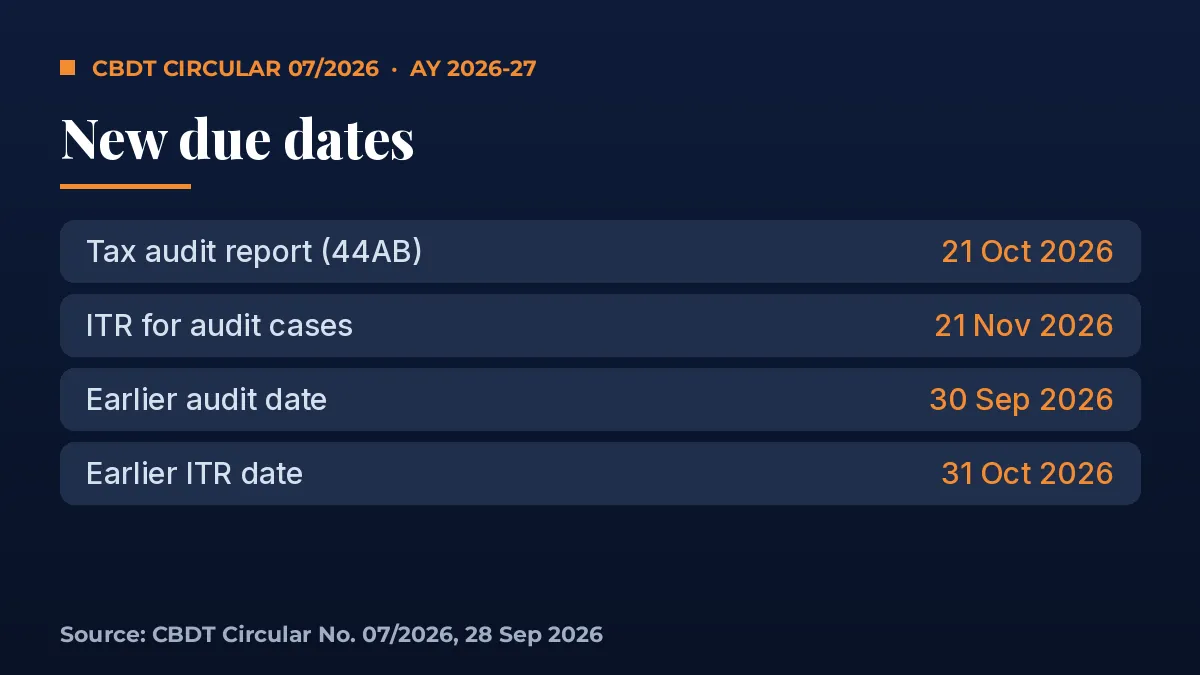
    The tax audit due date for Assessment Year 2026-27 is now 21 October 2026, not 30 September. The Central Board of Direct Taxes (CBDT) extended it through Circular No. 07/2026 dated 28 September 2026, and moved the income tax return (ITR) due date for audit cases from 31 October to 21 November 2026.

    That leaves just four days for audit reports. Who exactly gets the extra time, what happens if you miss it, and what should you finish this week? Here is a practical guide based on the circular and the Income-tax Act, 1961, which still governs this year’s return.

    What the CBDT Circular Says

    CBDT issued Circular No. 07/2026 under section 119 of the Income-tax Act, 1961, read with section 536 of the Income-tax Act, 2025. It makes two changes for Assessment Year 2026-27, which covers income earned in Previous Year 2025-26.

    ComplianceOriginal dateExtended date
    Tax audit report under section 44AB30 September 202621 October 2026
    ITR for persons at Sl. No. 2 (audit cases)31 October 202621 November 2026

    The circular extends the return due date for “the persons referred in sl.no.2 of the table below Explanation 2 to sub-section (1) of section 139”. As a consequence, the specified date for the audit report moves to 21 October under clause (ii) of the Explanation to section 44AB.

    Tax audit due date extended to 21 October 2026 and ITR due date to 21 November 2026 under CBDT Circular 07/2026
    Both dates moved by three weeks.

    Why does a 2025 Act appear in a 1961 Act circular? The Income-tax Act, 2025 replaced the old law from 1 April 2026. However, section 536 of the new Act preserves the old provisions for earlier years. Therefore, returns and audits for income of 2025-26 still follow the 1961 Act. Our explainer on the Income-tax Act 2025 transition covers this in detail.

    Who Gets the Extended Tax Audit Due Date?

    The extension applies only to the audit category. In practice, that means taxpayers whose accounts must be audited under the Income-tax Act or another law, along with working partners of such firms. Companies are also in this category.

    You need a tax audit for 2025-26 if, broadly:

    • Your business turnover exceeded ₹1 crore, or ₹10 crore where cash receipts and cash payments were each no more than 5% of the total.
    • Your professional gross receipts exceeded ₹50 lakh.
    • You opted out of presumptive taxation under section 44AD or 44ADA in certain cases and your income exceeds the basic exemption limit.

    For the full threshold rules, see our guide to tax audit thresholds under section 44AB. If you use the presumptive scheme, our note on sections 44AD and 44ADA explains when audit applies.

    Who Is Not Covered

    The circular is narrow, so read it carefully. It does not change the tax audit due date for anyone outside the audit category, simply because they never had one. More importantly, it does not mention transfer pricing cases that file Form 3CEB under section 92E, so those taxpayers should not assume any change to their own timelines.

    Likewise, individuals and businesses that do not need an audit are unaffected. If your return was due earlier and you missed it, the circular does not help you. You can still file a belated return by 31 December 2026, as the Income Tax Department’s return-of-income page confirms for AY 2026-27, unless the assessment is completed earlier.

    What Happens If You Miss 21 October

    Missing the tax audit due date has a direct cost. Under section 271B, the penalty for failing to get accounts audited or to furnish the report by the specified date is 0.5% of turnover or gross receipts, up to a maximum of ₹1.5 lakh.

    There is a defence. Section 273B allows relief where the taxpayer shows a reasonable cause for the failure. However, a busy CA or a late accountant is rarely accepted as reasonable cause, so do not rely on it.

    Late filing of the return brings separate costs:

    • Late fee under section 234F: ₹5,000, or ₹1,000 if total income does not exceed ₹5 lakh.
    • Interest: Interest under sections 234A and 234B runs at 1% a month on unpaid tax, so paying self-assessment tax early reduces the bill.
    • Loss of carry-forward: Business losses cannot be carried forward if the return is not filed by the due date.
    Penalty for missing the tax audit report: 0.5% of turnover up to ₹1.5 lakh, plus ITR late fee
    The penalty is capped, but avoidable.

    Your Four-Day Checklist Before the Tax Audit Due Date

    With the deadline on Wednesday, 21 October, here is what to finish now:

    1. Finalise books. Close the ledger for 2025-26, pass year-end entries and freeze the trial balance.
    2. Reconcile GST and TDS. Match turnover with GSTR-1 and GSTR-3B, and TDS credits with Form 26AS and the Annual Information Statement (AIS).
    3. Check MSME payments. Form 3CD requires disclosure of amounts due to micro and small enterprises; late payments can be disallowed under section 43B(h).
    4. Review cash transactions. Verify compliance with sections 269ST and 40A(3), which are reported in Form 3CD.
    5. Assign the CA on the portal. The taxpayer must add the chartered accountant for Form 3CA-3CD or 3CB-3CD on the e-filing portal.
    6. Accept the uploaded report. After the CA uploads the audit report, the taxpayer must approve it from their own login. Until then, it is not treated as filed.

    Form 3CA vs Form 3CB: Which One Applies?

    The audit report has two parts. The first is the audit opinion, and the second is Form 3CD, the statement of particulars.

    • Form 3CA with 3CD: Used where accounts are already audited under another law, such as companies under the Companies Act.
    • Form 3CB with 3CD: Used where accounts are not required to be audited under any other law, for example most proprietors and many partnership firms.

    Form 3CD is detailed. It covers depreciation, deemed income, TDS compliance, loans and deposits, GST registration and many other items. Because of this, it is the part that takes the most time, and the part where errors draw notices later.

    Checklist to complete the audit report and Form 3CD before the 21 October 2026 deadline
    The taxpayer’s acceptance completes the filing.

    After the Audit: Planning the ITR by 21 November

    Once the audit report is filed, the return follows. The ITR for audit cases is now due on 21 November 2026. Most companies use ITR-6, firms use ITR-5, and individuals with business income use ITR-3.

    The figures in the return must match the audit report. Mismatches between Form 3CD and the ITR are a common reason for defective-return notices under section 139(9). Moreover, keep your advance tax planning for the current year on track, as the third instalment is due on 15 December; our guide to advance tax rules explains the schedule.

    Five Insights for Taxpayers and Professionals

    • The extension is three weeks, not a reprieve. Both dates moved by the same margin, so the usual one-month gap between audit and return remains.
    • Only audit cases benefit. Check your category before relying on 21 November.
    • Acceptance matters. An audit report uploaded by the CA but not approved by the taxpayer is incomplete.
    • Penalties are capped but real. Up to ₹1.5 lakh under section 271B is avoidable with a few days’ work.
    • This is the last year under the old Act. From next year, audits and returns move to the Income-tax Act, 2025 framework.

    What Happens Next

    CBDT has not signalled any further extension, so treat 21 October 2026 as final for the tax audit due date and 21 November 2026 for the return. Portal traffic usually peaks in the last 48 hours, so upload early. If you are a business owner, call your CA today to confirm the audit status and approve the report as soon as it is uploaded.

    Frequently Asked Questions

    What is the tax audit due date for AY 2026-27?

    The tax audit due date for AY 2026-27 is 21 October 2026. CBDT extended it from 30 September 2026 through Circular No. 07/2026 dated 28 September 2026. The ITR due date for these audit cases moves from 31 October to 21 November 2026.

    Does the extension apply to all taxpayers?

    No. It covers only persons at Sl. No. 2 of the table below Explanation 2 to section 139(1), broadly companies and taxpayers whose accounts must be audited, plus working partners of such firms. Taxpayers who do not need an audit get no extra time from this circular.

    What is the penalty for late filing of the tax audit report?

    Under section 271B, the penalty is 0.5% of total sales, turnover or gross receipts, subject to a maximum of ₹1.5 lakh. It can be waived under section 273B only if the taxpayer proves a reasonable cause for the delay.

    Who files the tax audit report on the portal?

    The chartered accountant uploads Form 3CA-3CD or 3CB-3CD on the income tax e-filing portal after the taxpayer assigns the form to them. The taxpayer must then accept the report from their own login for it to count as filed.

    Sources

    How we verified: dates and wording are taken from CBDT Circular No. 07/2026; penalties from the Income-tax Act, 1961. This article is general information, not professional advice for your case. Consult your chartered accountant before acting.