
Updated: 17 October 2026, 9:30 AM IST | By PK
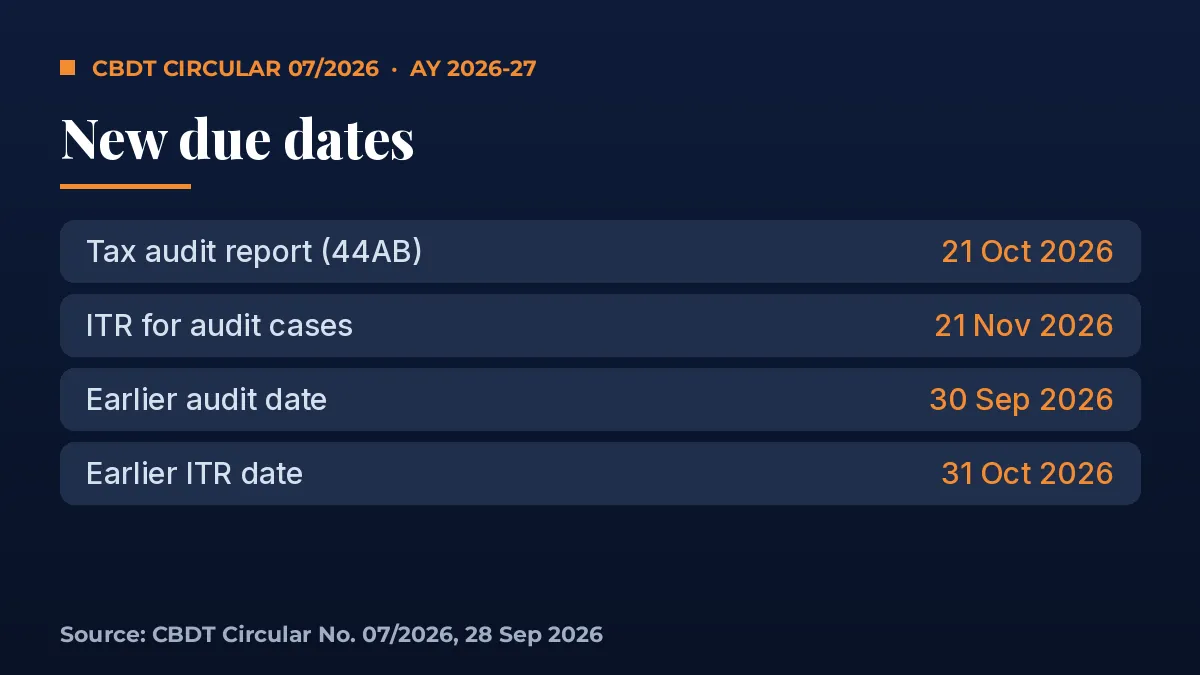
The tax audit due date for Assessment Year 2026-27 is now 21 October 2026, not 30 September. The Central Board of Direct Taxes (CBDT) extended it through Circular No. 07/2026 dated 28 September 2026, and moved the income tax return (ITR) due date for audit cases from 31 October to 21 November 2026.
That leaves just four days for audit reports. Who exactly gets the extra time, what happens if you miss it, and what should you finish this week? Here is a practical guide based on the circular and the Income-tax Act, 1961, which still governs this year’s return.
Table of Contents
What the CBDT Circular Says
CBDT issued Circular No. 07/2026 under section 119 of the Income-tax Act, 1961, read with section 536 of the Income-tax Act, 2025. It makes two changes for Assessment Year 2026-27, which covers income earned in Previous Year 2025-26.
| Compliance | Original date | Extended date |
|---|---|---|
| Tax audit report under section 44AB | 30 September 2026 | 21 October 2026 |
| ITR for persons at Sl. No. 2 (audit cases) | 31 October 2026 | 21 November 2026 |
The circular extends the return due date for “the persons referred in sl.no.2 of the table below Explanation 2 to sub-section (1) of section 139”. As a consequence, the specified date for the audit report moves to 21 October under clause (ii) of the Explanation to section 44AB.
Why does a 2025 Act appear in a 1961 Act circular? The Income-tax Act, 2025 replaced the old law from 1 April 2026. However, section 536 of the new Act preserves the old provisions for earlier years. Therefore, returns and audits for income of 2025-26 still follow the 1961 Act. Our explainer on the Income-tax Act 2025 transition covers this in detail.
Who Gets the Extended Tax Audit Due Date?
The extension applies only to the audit category. In practice, that means taxpayers whose accounts must be audited under the Income-tax Act or another law, along with working partners of such firms. Companies are also in this category.
You need a tax audit for 2025-26 if, broadly:
- Your business turnover exceeded ₹1 crore, or ₹10 crore where cash receipts and cash payments were each no more than 5% of the total.
- Your professional gross receipts exceeded ₹50 lakh.
- You opted out of presumptive taxation under section 44AD or 44ADA in certain cases and your income exceeds the basic exemption limit.
For the full threshold rules, see our guide to tax audit thresholds under section 44AB. If you use the presumptive scheme, our note on sections 44AD and 44ADA explains when audit applies.
Who Is Not Covered
The circular is narrow, so read it carefully. It does not change the tax audit due date for anyone outside the audit category, simply because they never had one. More importantly, it does not mention transfer pricing cases that file Form 3CEB under section 92E, so those taxpayers should not assume any change to their own timelines.
Likewise, individuals and businesses that do not need an audit are unaffected. If your return was due earlier and you missed it, the circular does not help you. You can still file a belated return by 31 December 2026, as the Income Tax Department’s return-of-income page confirms for AY 2026-27, unless the assessment is completed earlier.
What Happens If You Miss 21 October
Missing the tax audit due date has a direct cost. Under section 271B, the penalty for failing to get accounts audited or to furnish the report by the specified date is 0.5% of turnover or gross receipts, up to a maximum of ₹1.5 lakh.
There is a defence. Section 273B allows relief where the taxpayer shows a reasonable cause for the failure. However, a busy CA or a late accountant is rarely accepted as reasonable cause, so do not rely on it.
Late filing of the return brings separate costs:
- Late fee under section 234F: ₹5,000, or ₹1,000 if total income does not exceed ₹5 lakh.
- Interest: Interest under sections 234A and 234B runs at 1% a month on unpaid tax, so paying self-assessment tax early reduces the bill.
- Loss of carry-forward: Business losses cannot be carried forward if the return is not filed by the due date.

Your Four-Day Checklist Before the Tax Audit Due Date
With the deadline on Wednesday, 21 October, here is what to finish now:
- Finalise books. Close the ledger for 2025-26, pass year-end entries and freeze the trial balance.
- Reconcile GST and TDS. Match turnover with GSTR-1 and GSTR-3B, and TDS credits with Form 26AS and the Annual Information Statement (AIS).
- Check MSME payments. Form 3CD requires disclosure of amounts due to micro and small enterprises; late payments can be disallowed under section 43B(h).
- Review cash transactions. Verify compliance with sections 269ST and 40A(3), which are reported in Form 3CD.
- Assign the CA on the portal. The taxpayer must add the chartered accountant for Form 3CA-3CD or 3CB-3CD on the e-filing portal.
- Accept the uploaded report. After the CA uploads the audit report, the taxpayer must approve it from their own login. Until then, it is not treated as filed.
Form 3CA vs Form 3CB: Which One Applies?
The audit report has two parts. The first is the audit opinion, and the second is Form 3CD, the statement of particulars.
- Form 3CA with 3CD: Used where accounts are already audited under another law, such as companies under the Companies Act.
- Form 3CB with 3CD: Used where accounts are not required to be audited under any other law, for example most proprietors and many partnership firms.
Form 3CD is detailed. It covers depreciation, deemed income, TDS compliance, loans and deposits, GST registration and many other items. Because of this, it is the part that takes the most time, and the part where errors draw notices later.

After the Audit: Planning the ITR by 21 November
Once the audit report is filed, the return follows. The ITR for audit cases is now due on 21 November 2026. Most companies use ITR-6, firms use ITR-5, and individuals with business income use ITR-3.
The figures in the return must match the audit report. Mismatches between Form 3CD and the ITR are a common reason for defective-return notices under section 139(9). Moreover, keep your advance tax planning for the current year on track, as the third instalment is due on 15 December; our guide to advance tax rules explains the schedule.
Five Insights for Taxpayers and Professionals
- The extension is three weeks, not a reprieve. Both dates moved by the same margin, so the usual one-month gap between audit and return remains.
- Only audit cases benefit. Check your category before relying on 21 November.
- Acceptance matters. An audit report uploaded by the CA but not approved by the taxpayer is incomplete.
- Penalties are capped but real. Up to ₹1.5 lakh under section 271B is avoidable with a few days’ work.
- This is the last year under the old Act. From next year, audits and returns move to the Income-tax Act, 2025 framework.
What Happens Next
CBDT has not signalled any further extension, so treat 21 October 2026 as final for the tax audit due date and 21 November 2026 for the return. Portal traffic usually peaks in the last 48 hours, so upload early. If you are a business owner, call your CA today to confirm the audit status and approve the report as soon as it is uploaded.
Frequently Asked Questions
What is the tax audit due date for AY 2026-27?
The tax audit due date for AY 2026-27 is 21 October 2026. CBDT extended it from 30 September 2026 through Circular No. 07/2026 dated 28 September 2026. The ITR due date for these audit cases moves from 31 October to 21 November 2026.
Does the extension apply to all taxpayers?
No. It covers only persons at Sl. No. 2 of the table below Explanation 2 to section 139(1), broadly companies and taxpayers whose accounts must be audited, plus working partners of such firms. Taxpayers who do not need an audit get no extra time from this circular.
What is the penalty for late filing of the tax audit report?
Under section 271B, the penalty is 0.5% of total sales, turnover or gross receipts, subject to a maximum of ₹1.5 lakh. It can be waived under section 273B only if the taxpayer proves a reasonable cause for the delay.
Who files the tax audit report on the portal?
The chartered accountant uploads Form 3CA-3CD or 3CB-3CD on the income tax e-filing portal after the taxpayer assigns the form to them. The taxpayer must then accept the report from their own login for it to count as filed.
Sources
- CBDT Circular No. 07/2026 dated 28 September 2026
- Income Tax Department: Return of income and due dates
- Income Tax e-filing portal
How we verified: dates and wording are taken from CBDT Circular No. 07/2026; penalties from the Income-tax Act, 1961. This article is general information, not professional advice for your case. Consult your chartered accountant before acting.