
Updated: 16 October 2026 | By PK
The Income-tax Act 2025 replaced the Income-tax Act, 1961 on 1 April 2026, and it applies to income earned from Tax Year 2026-27 onwards. According to the Press Information Bureau, it simplifies the language and structure of the law without changing the underlying tax policy. The bigger practical change is the transition: for the next few years, many taxpayers will deal with both Acts at the same time.
This guide explains what changed, what did not, and how the old and new laws apply to returns, advance tax, TDS and pending cases. Every figure below comes from the Income Tax Department or PIB.
Table of Contents
What Is the Income-tax Act 2025?
The Income-tax Bill, 2025 was passed by Parliament on 12 August 2025 and received the President’s assent on 21 August 2025. It then became the Income-tax Act, 2025. As section 1 of the Act states, it came into force on 1 April 2026.
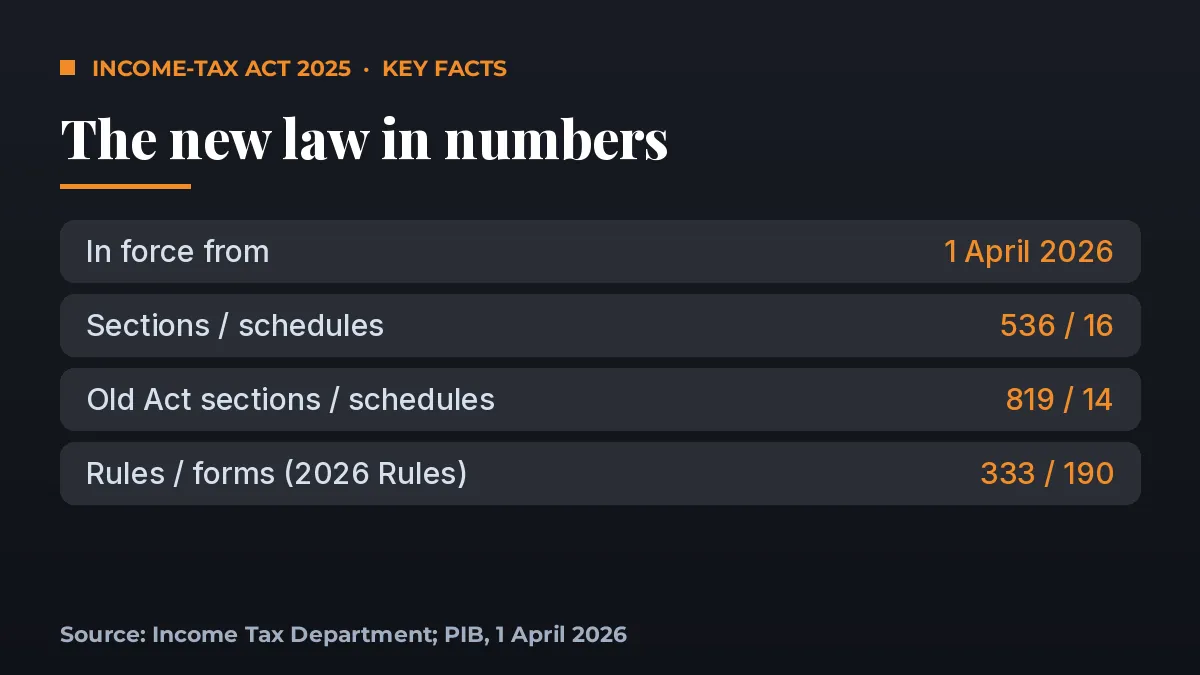
The government’s stated aim was simplification. The Income Tax Department says the new law contains 536 sections and 16 schedules, compared with 819 sections and 14 schedules in the 1961 Act. Cross-references are more direct, provisos and explanations have been reduced, and many rules are presented in tables.
The Central Board of Direct Taxes notified the Income-tax Rules, 2026 on 20 March 2026, also effective from 1 April 2026. According to the Department, the rules have been cut from 511 rules and 399 forms to 333 rules and 190 forms.
“Tax Year” Replaces Previous Year and Assessment Year
The change most taxpayers will notice first is a new term. The 1961 Act used two different years: the “previous year”, in which income was earned, and the “assessment year”, in which it was assessed. That often confused taxpayers.
Under the Income-tax Act 2025, there is one term: tax year. The Income Tax Department defines it as the twelve-month period of the financial year in which income is earned. Income earned from 1 April 2026 to 31 March 2027 is therefore “Tax Year 2026-27”.
The underlying system does not change. Income is still assessed after the year ends, just as previous-year income was assessed under the old Act. Only the label is simpler.
Old Act vs New Act: Which Law Applies When?
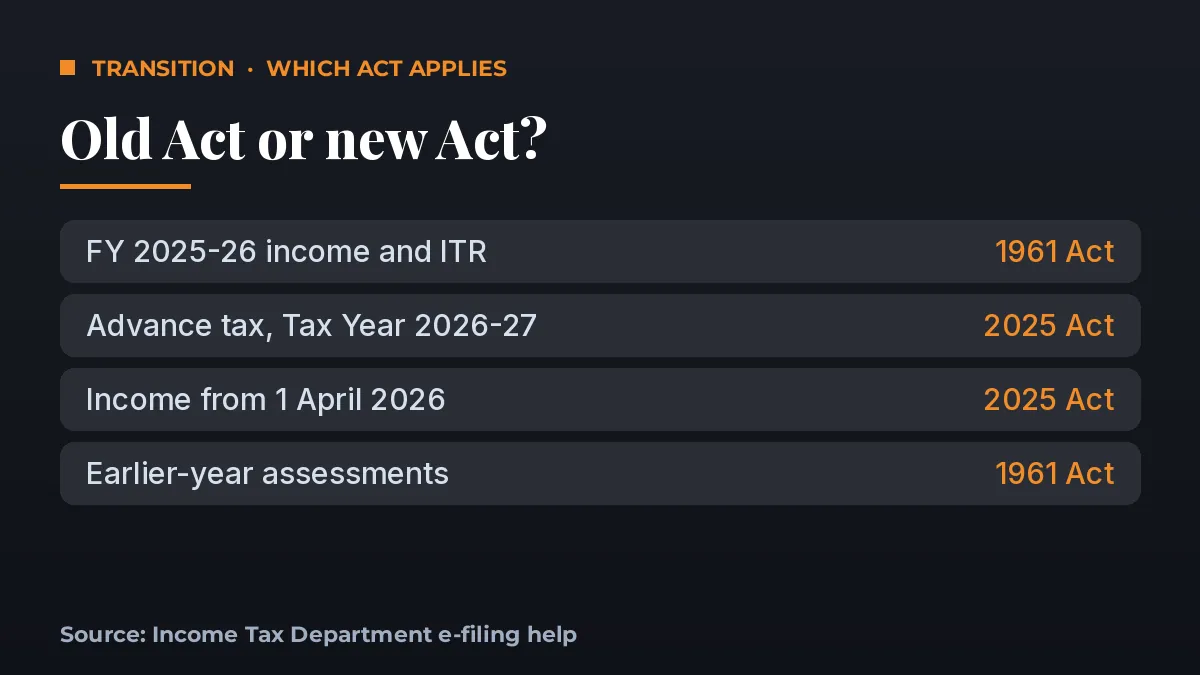
The Income Tax Department has explained that the 1961 Act stands repealed from 1 April 2026, but its provisions continue to govern all tax years beginning before that date. In practice, this means:
| Situation | Law that applies |
|---|---|
| Income of FY 2025-26 (AY 2026-27) | Income-tax Act, 1961 |
| ITR for AY 2026-27, filed in 2026 | Old Act forms |
| Advance tax for Tax Year 2026-27 (from June 2026) | Income-tax Act 2025 |
| Income earned from 1 April 2026 | Income-tax Act 2025 |
| Assessments and appeals for earlier years | Income-tax Act, 1961, until finally resolved |
The e-filing portal supports compliance under both Acts at once. As a result, a business may file an audit report and return under the old Act for FY 2025-26 while paying advance tax and filing TDS statements under the new Act for Tax Year 2026-27.
For example, tax audit cases for AY 2026-27 are still governed by the 1961 Act. That is why the extended due dates in CBDT Circular No. 07/2026 (tax audit report by 21 October 2026 and return by 21 November 2026) refer to the old framework. See our guide to tax audit thresholds and penalties for the audit rules that apply to that year.
What Changed and What Did Not
PIB described the Income-tax Act 2025 as a shift towards clarity, simpler language and a reader-friendly structure “without altering the underlying tax policy”. That is the key point for most taxpayers.
What changed:
- Structure and numbering: section numbers are different. A provision you knew by its 1961 section number now sits under a new number.
- Terminology: “tax year” replaces “previous year” and “assessment year”.
- Forms: the rules and forms were re-numbered and redesigned. For instance, quarterly TDS statements are now filed on new forms, such as Form 138 for TDS on salary and Form 140 for TDS on other payments to residents.
- Presentation: more tables and formulas, fewer long provisos.
What did not change in principle:
- The broad policy framework for computing and taxing income.
- Rates and slabs, which continue to be set through annual Finance Acts.
- The obligation to pay advance tax, deduct TDS and file returns on time.
That said, Finance Act 2026 amended the new Act before it took effect. So always read the Act “as amended”, which the Department publishes on its website.
How the Income-tax Act 2025 Affects Different Taxpayers
Salaried employees
Your employer’s TDS on salary from April 2026 runs under the new Act and the new forms. Your return for FY 2025-26, filed in 2026, used the old Act’s forms. When you plan investments or deductions, check the new section references in your Form 16 equivalent and in declarations to your employer.
Businesses and professionals
Advance tax instalments for Tax Year 2026-27 are paid under the new Act. Professionals using presumptive taxation should review how those provisions are numbered and worded now. Our guides on advance tax for professionals and presumptive taxation explain the logic, which continues; check the new section references before filing.
Deductors and collectors
TDS and TCS compliance moved to new forms from the first quarter of Tax Year 2026-27. Software, challans and returns must use the new references. For the conceptual difference between TDS on purchases and TCS on sales, see our explainer on TDS on purchase of goods versus TCS on sale.
Practical Transition Checklist
- Map your key sections. Use the Department’s utility that compares provisions of the 1961 Act and Rules with the 2025 Act and 2026 Rules.
- Update templates and software. Invoices, TDS certificates, engagement letters and accounting software should use the new references for Tax Year 2026-27.
- Keep two files. Separate papers for FY 2025-26 (old Act) and Tax Year 2026-27 (new Act) avoid mix-ups in notices and assessments.
- Read the Department’s FAQs. The FAQs on interplay and transition between the two Acts answer many common questions.
- Check notices carefully. A notice for an earlier year will cite the 1961 Act. A notice for Tax Year 2026-27 onwards will cite the new Act.
Five Insights on the New Law
- In force since 1 April 2026. It applies from Tax Year 2026-27.
- Simpler, not a new tax policy. PIB says the underlying policy is unchanged.
- Two Acts run side by side. Earlier years stay under the 1961 Act until closed.
- Fewer sections and forms. 536 sections and 16 schedules; 333 rules and 190 forms.
- Numbers changed, so check references. Old section numbers no longer apply to new-year compliance.
What Happens Next
The first full returns under the Income-tax Act 2025 will be for Tax Year 2026-27, filed in 2027. Expect more CBDT circulars, FAQs and form updates as that date approaches. Meanwhile, keep an eye on the old-Act deadlines for FY 2025-26, especially the tax audit and return dates extended by Circular 07/2026.
Frequently Asked Questions
When did the Income-tax Act 2025 come into force?
The Income-tax Act 2025 came into force on 1 April 2026, as section 1 of the Act provides and PIB confirmed. It applies to income earned from Tax Year 2026-27 onwards. Income of earlier years continues to be governed by the Income-tax Act, 1961, including assessments and appeals for those years.
What is a tax year under the new Act?
A tax year is the twelve-month financial year in which income is earned, from 1 April to 31 March. It replaces the separate “previous year” and “assessment year” used under the 1961 Act. Income earned between 1 April 2026 and 31 March 2027 is Tax Year 2026-27.
Which Act applies to my return filed in 2026?
Returns for AY 2026-27, covering income of FY 2025-26, are filed under the Income-tax Act, 1961 using the old Act’s forms. However, advance tax for Tax Year 2026-27, starting June 2026, is paid under the new Act. The e-filing portal supports both.
Have income tax rates changed because of the new Act?
PIB says the new Act simplifies the law without changing the underlying tax policy. Rates and slabs continue to be set by annual Finance Acts. So any change in rates comes from the Finance Act for that year, not from the switch to the new Act itself.
How do I find the new section for an old provision?
The Income Tax Department has published utilities that map provisions and forms of the 1961 Act and Rules to the 2025 Act and 2026 Rules. You can find them on the Department’s Income-tax Act 2025 page, along with FAQs and guidance notes on the transition.
Sources
- PIB: Income-tax Act, 2025 comes into force from 1 April 2026
- Income Tax Department: objective and scope of the new Act
- Income Tax Department: Income-tax Act 2025, Rules 2026 and utilities
- Income-tax Act, 2025 as amended by Finance Act, 2026 (PDF)
Disclaimer: This article is general information, not professional tax advice. Please consult a Chartered Accountant for your specific situation.